
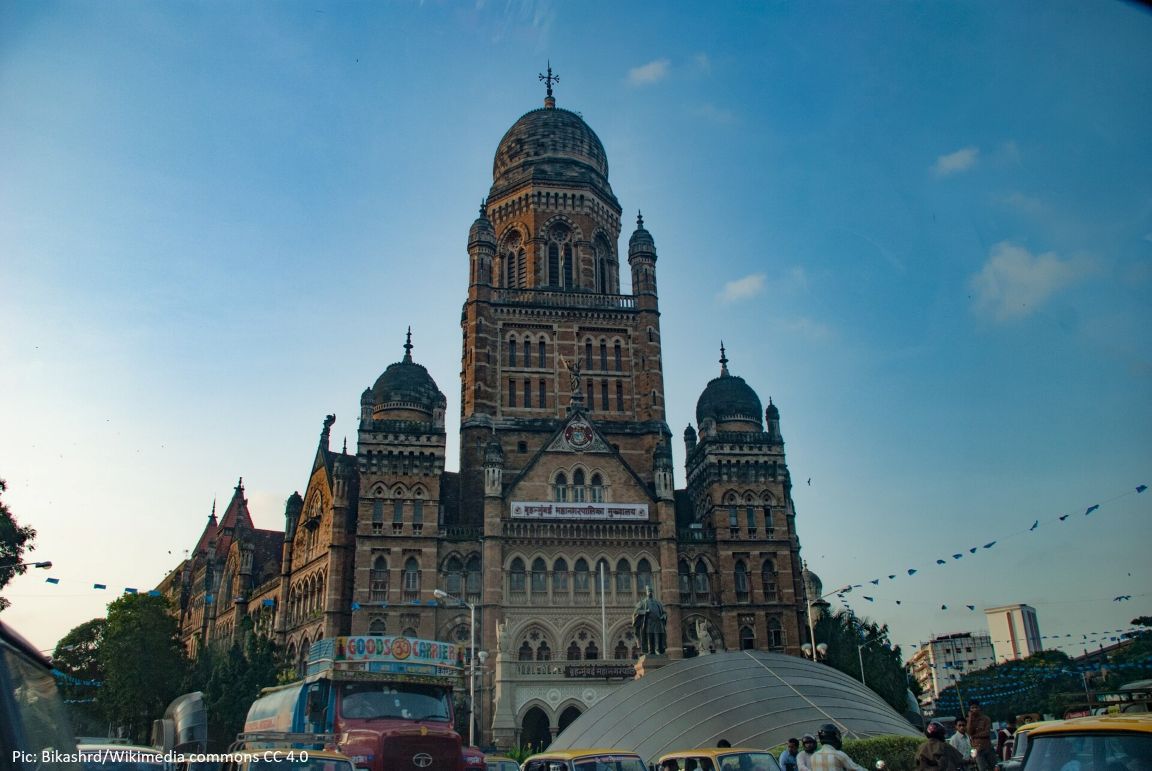
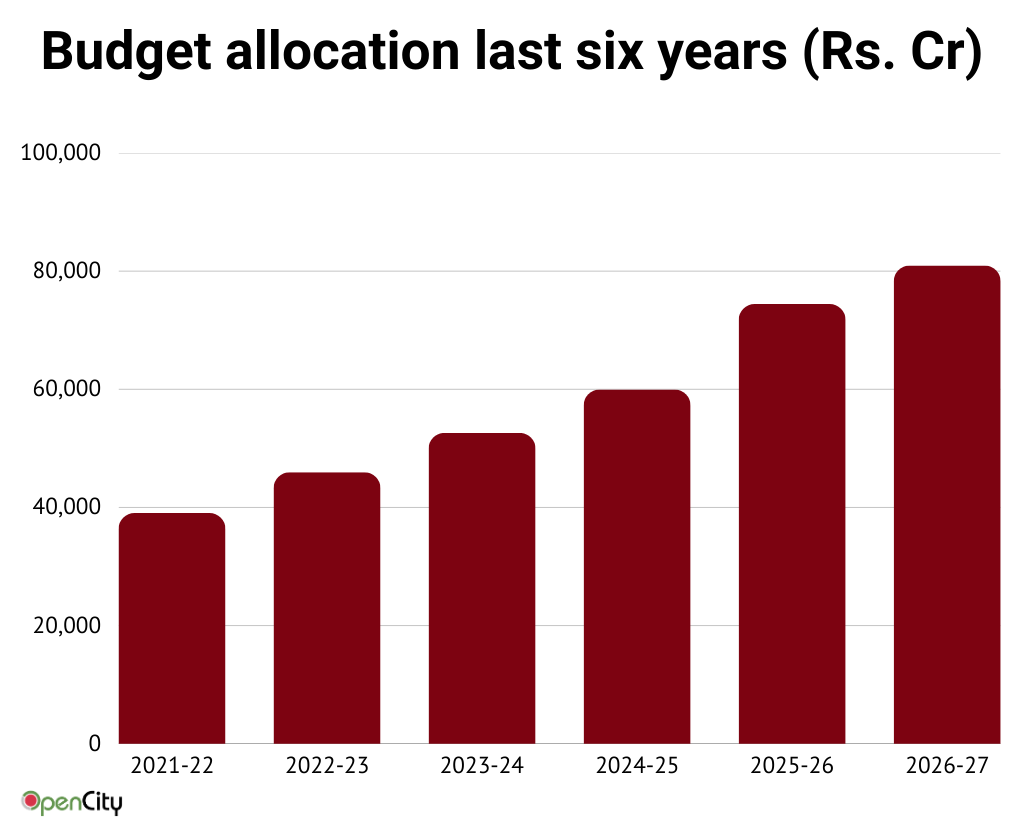
The Brihanmumbai Municipal Corporation announced a budget with an allocation of a whopping Rs. 80,952.56 Cr. This marks an increase of 8.7% from the previous year’s allocation.
While the increase this year is only 8.7%, the budget has more than doubled from the Rs. 39,038 Cr allocation in 2021-22. It needs to be noted that unlike the urban local bodies of Bengaluru, Chennai and Hyderbad, the BMC also includes functions like water supply and sewerage which form a large component of the budget. You can find the budget documents from BMC here.
Budget heads for BMC
The BMC Budget is broken up into four individual “Budgets” each of which has sub components in the form of “Funds”. These four budgets and their component funds are:
- Budget A: This is known as the “General Budget” which includes the bulk of the allocations including for roads and health. It has two funds:
- Fund 11: General capital and revenue which includes allocation of infrastructure projects as well as spending on running the municipal corporation.
- Fund 12: Health allocations which includes general health as well medical health in the form of hospitals and primary care centres.
- Budget B: This is a smaller budget than “A” and includes the following funds:
- Fund 21: Improvement schemes including for People Affected by Projects (PAP)
- Fund 22: Slum clearance allocation
- Fund 23: Slum improvement allocations
- Fund 60: Provident fund allocations for current employees
- Fund 70: Pension allocations for former employees
- Budget E: This is the education budget where the allocations are for schools and other educational institutions run by the BMC. It has only one fund:
- Fund 30: Education fund
- Budget G: This budget details the water supply and sewerage department allocations. It also has only one fund:
- Fund 40: Water supply and sewerage
- Gender budget: Budget allocations for upliftment and empowerment of women and transgender people.
- DP 2034 budget: Allocations for the Development Plan 2034 which is Mumbai’s current Master Plan.
Split-up of budget
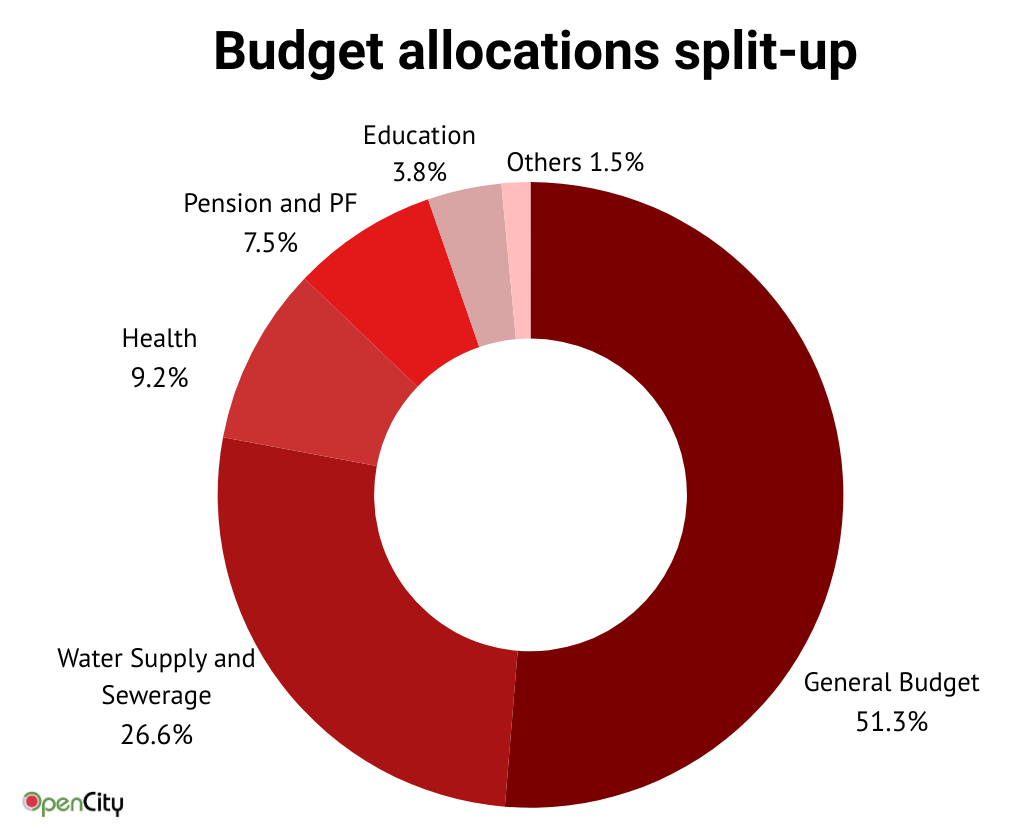
The Rs. 80,000 Cr is not uniformly split across the different budgets. General budget which includes roads and storm-water drains takes up more than half of the allocation. Water supply and sewerage follows at just over a quarter. The rest, including health and education make up less than a quarter of the budget. However, in terms of actual money, health and education get Rs. 7456 Cr and Rs. 3098 Cr respectively. Pension and provident fund are expected to cost the corporation Rs. 6100 Cr during the year.
Capital expenditure
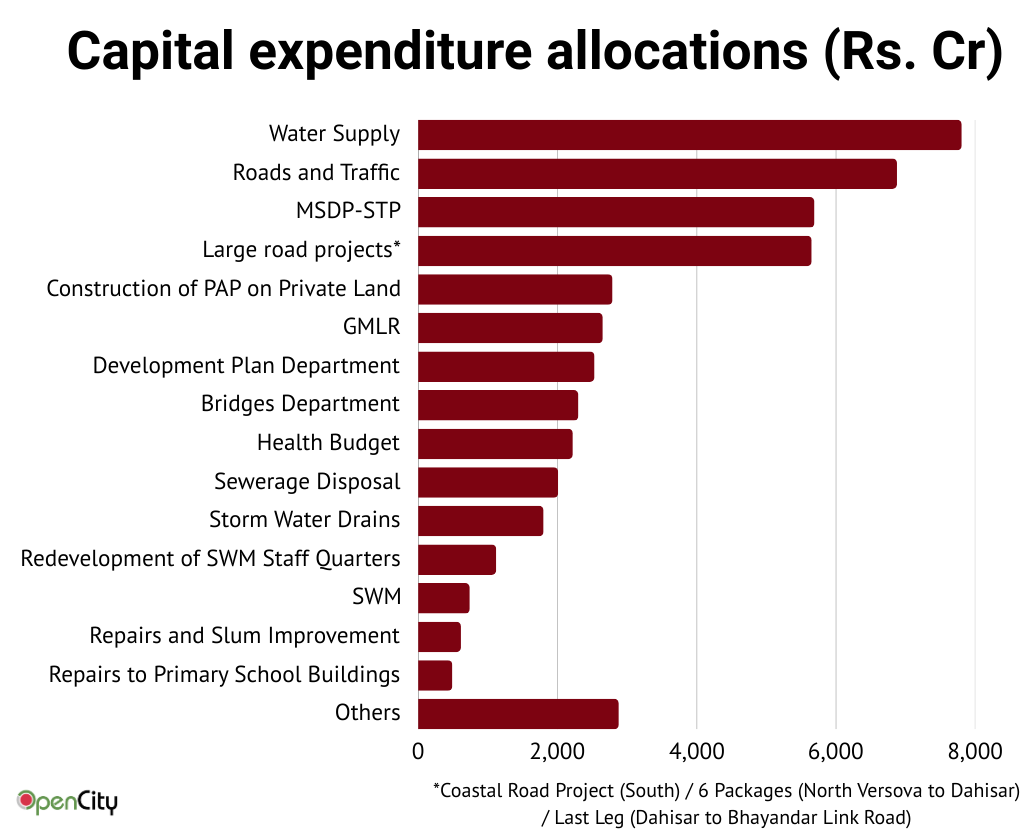
Capital expenditure refers to expenditure to build assets as against operation and maintenance. For instance, building a new flyover will be a capital expenditure, while fixing potholes or paying salaries of school teachers and employees will come under revenue expenditure, not capital.
The BMC budget allocates Rs. 48,164.26 Crore as capital expenditure. While water supply seems to be taking up the bulk of the expenditure, a closer look tells you that the biggest expense is roads. Roads and traffic, the coastal road, Goregaon Mulund Link Road along with bridges and storm-water drains take up the largest component of capital expenses. The two road projects – coastal road and the GMLR together account for Rs. 8300 Cr or more than 10% of the total allocation in the BMC budget, and almost 80% of the health and education budget combined.
Conclusions
The BMC budget has been on a rapidly increasing trend over the past few years and it has more than doubled in just five years. However, like with most cities, the bulk of the spending goes to capital expenditure, building large roads and flyovers.
Allocations are only one part of the story, and the proof of the pudding is in the actual expenditure. Looking at the actual spending through revised estimates can give us a clearer idea of how money was actually spent in the past year.
The BMC however, makes this a lot difficult by breaking up the funds into smaller components which are not added up. While revised estimates for the previous year are included, the actual allocations are not.
This is in contrast to city budgets in Bengaluru and Chennai where each head includes the actual spending from two years back, allocations in the previous year budget, revised estimates against those allocations and the allocations for the next year. The budget is thus not just a statement of how money will be spent during the upcoming year, but also how it was spent during the current and previous financial years.
Including such complete information across years, separating out capital and revenue for each department/budget and a summary at the larger budgets/funds level would help people clearly understand the allocations as well as how money was spent during the past year.