Tamil Nadu goes to the polls on April 23rd, 2026. The news cycles are heating up with parties presenting their manifestos and wooing voters with what they can offer during the next five years. Refrigerators, money to buy gadgets are some of the promises from political parties.
However, a crucial question remains, that of essential government services and how the government has fared on them in the last five years, and the gaps they need to close in the next five. What is the state of government schools, public healthcare centres, sanitation and water supply? Can the upcoming government and the new (or reelected) MLAs prioritise them?
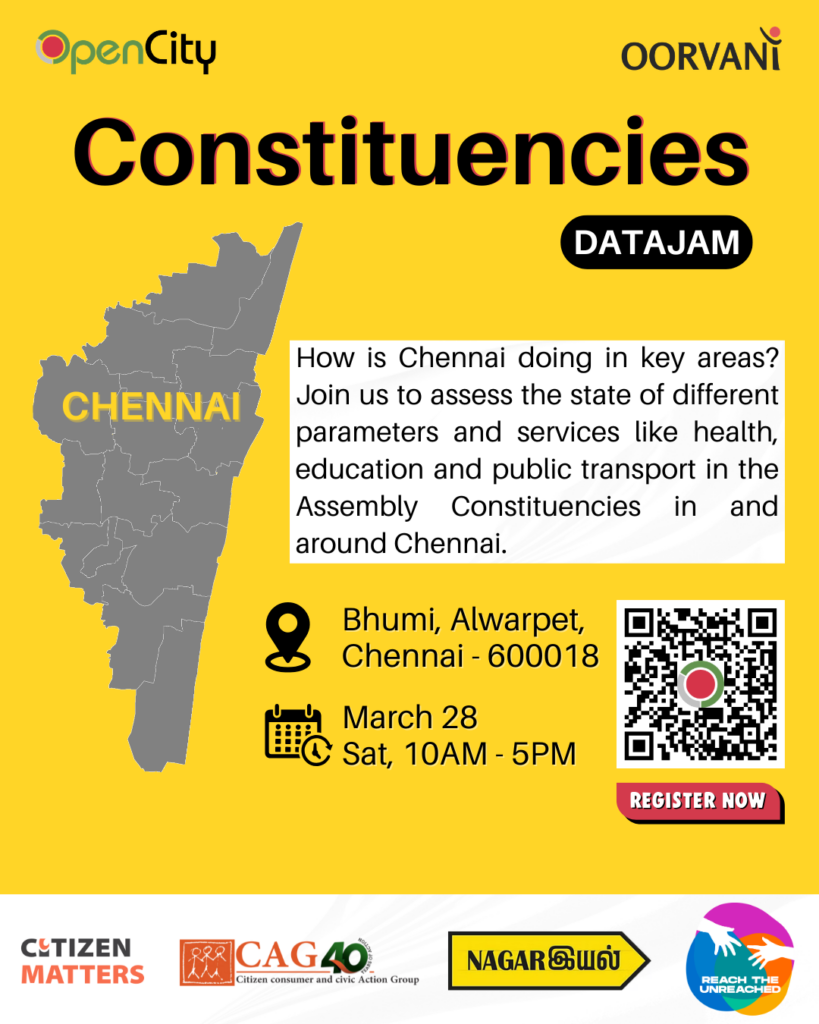
Chennai Constituencies Datajam
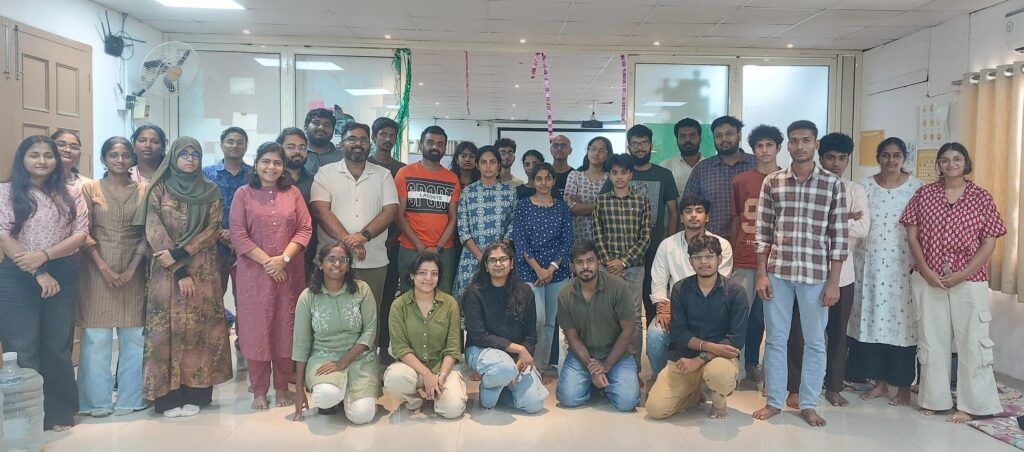
The Chennai constituencies datajam was held in this context with the goal of evaluating the state of essential government services in the constituencies in and around Chennai district and presenting data to show which services need to be addressed in which constituencies urgently. The datajam was conducted in partnership with Nagariyal, Citizen consumer and civic Action Group (CAG) Chennai and Reach the Unreached, at Bhumi – Alwarpet.
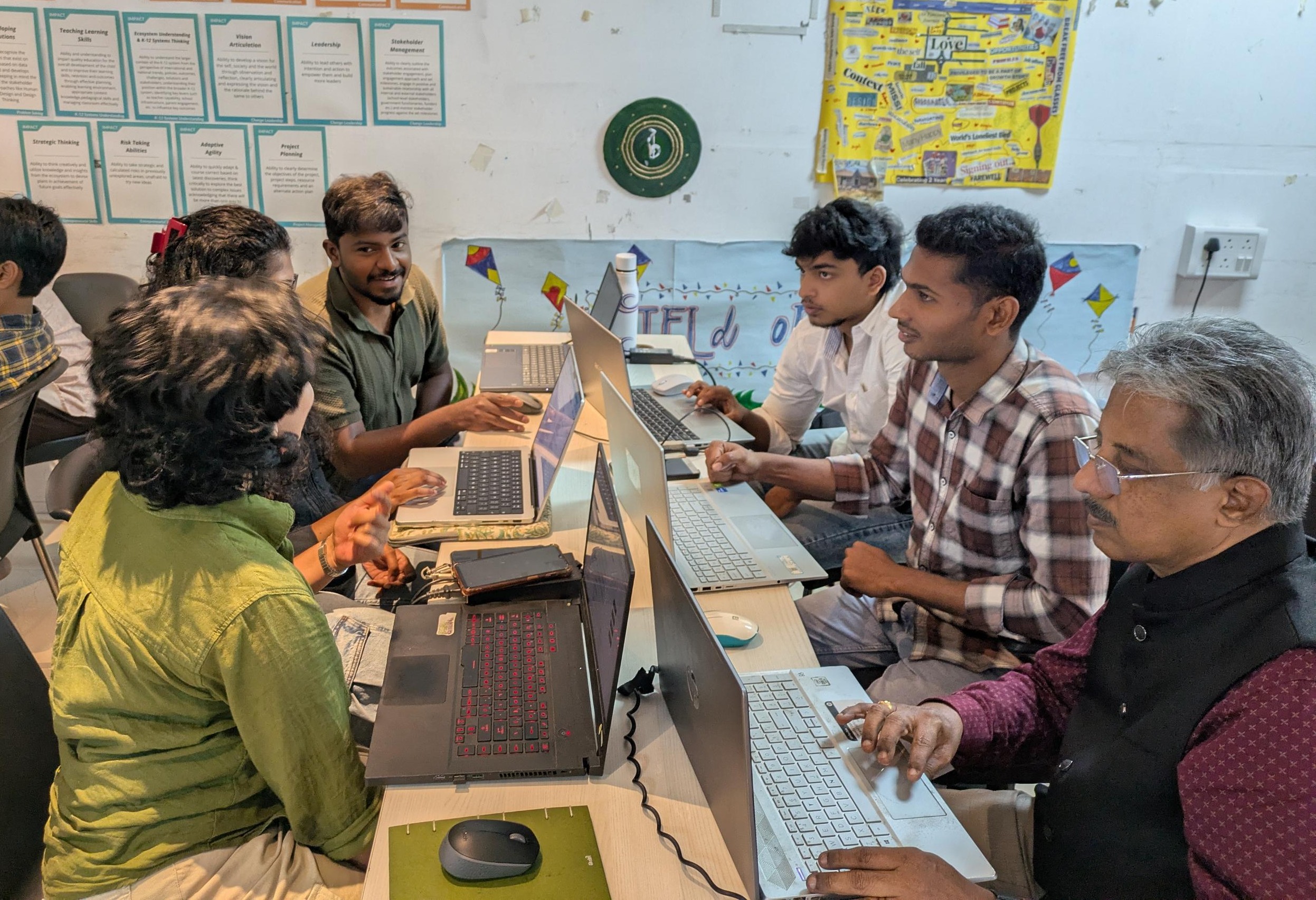
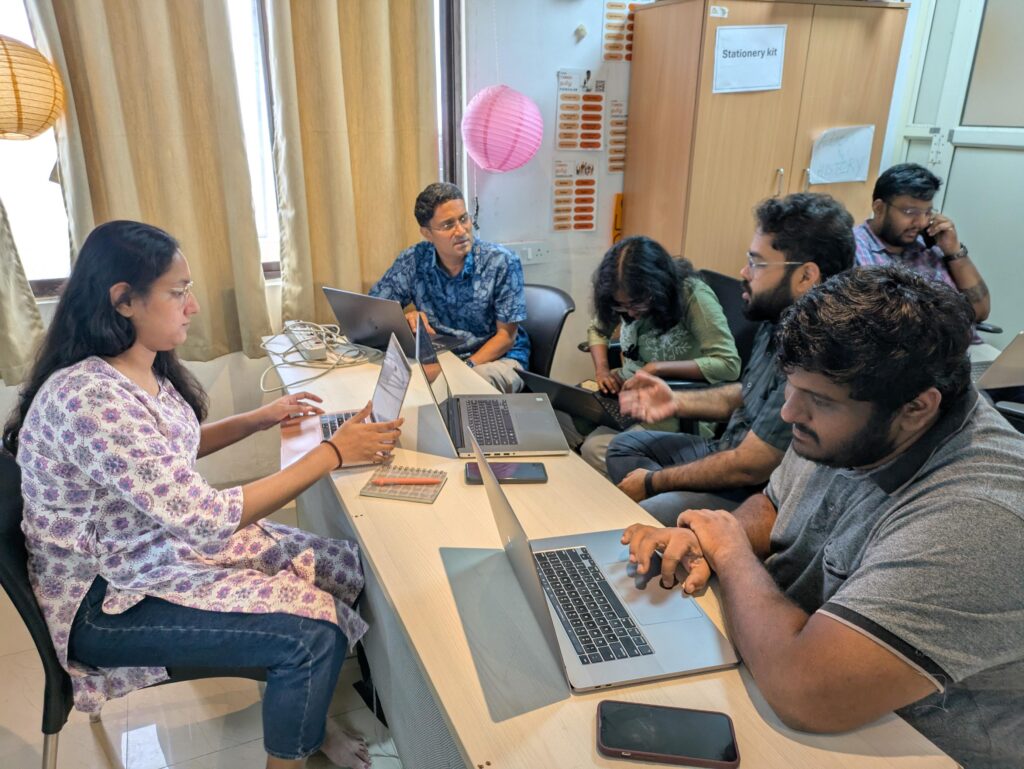
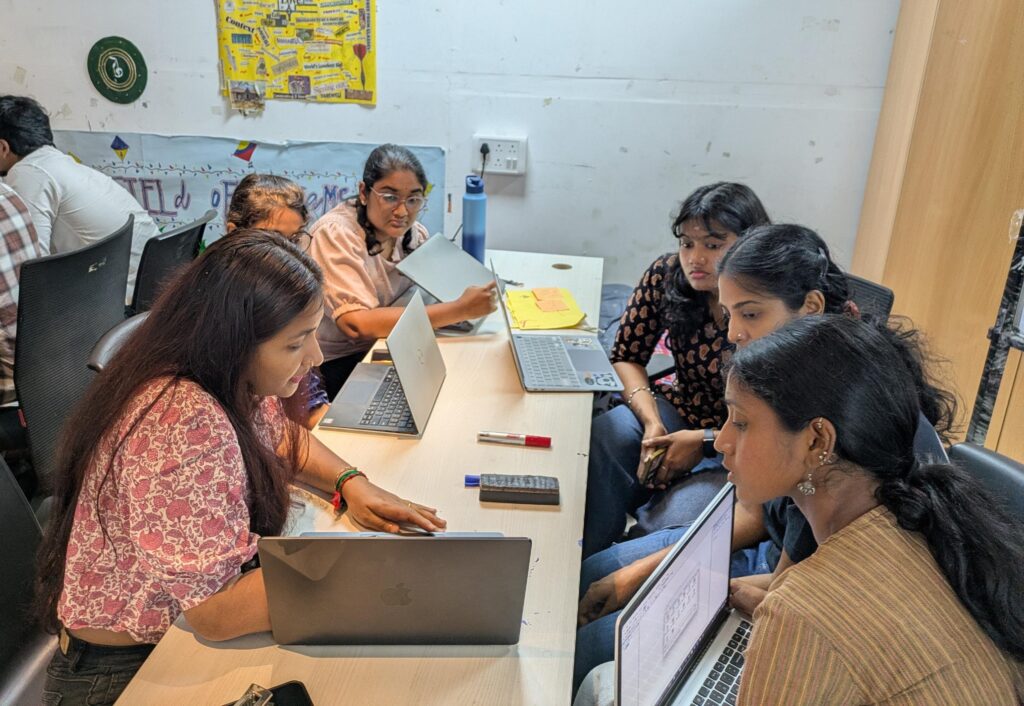
In the day long event, 30 participants from diverse backgrounds, including five high school students from Sunnyside Learning, looked at data on education, health, sanitation, open spaces, urban heat and voter turnout to evaluate the constituencies on multiple parameters.
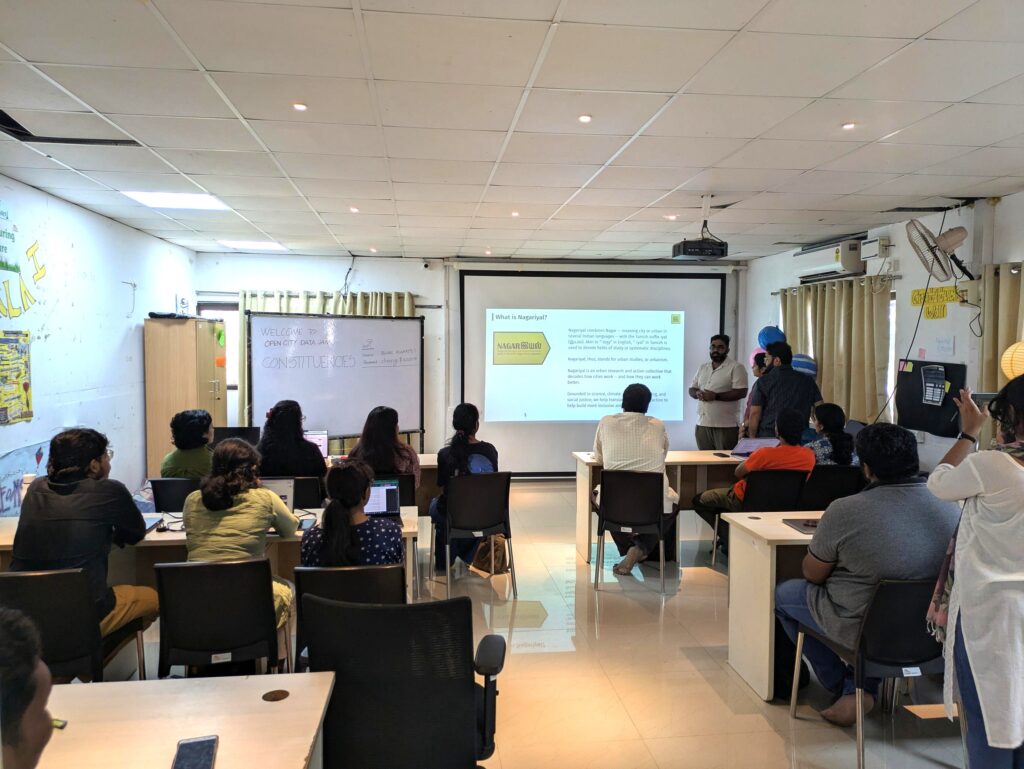
The participants looked at data on schools, open spaces, voter turnout, sewerage network, UPHCs, slums, census 2011 and satellite data for land surface temperature, built-up area and vegetation. The data was used to identify the constituencies in need of most intervention for specific parameters.
Problem Statements
The parameters and questions they sought to address were:
- State of government schools in the constituencies
- Access to sanitation and the sewerage network in the constituencies
- Exposure and vulnerability to urban heat in constituencies and level of adaptation and mitigation available
- Civic engagement and correlation to open spaces in three diverse constituencies
- Access to Public Health Care centres in Sholinganallur constituency.
Outputs
Education and socio-economic status of constituencies
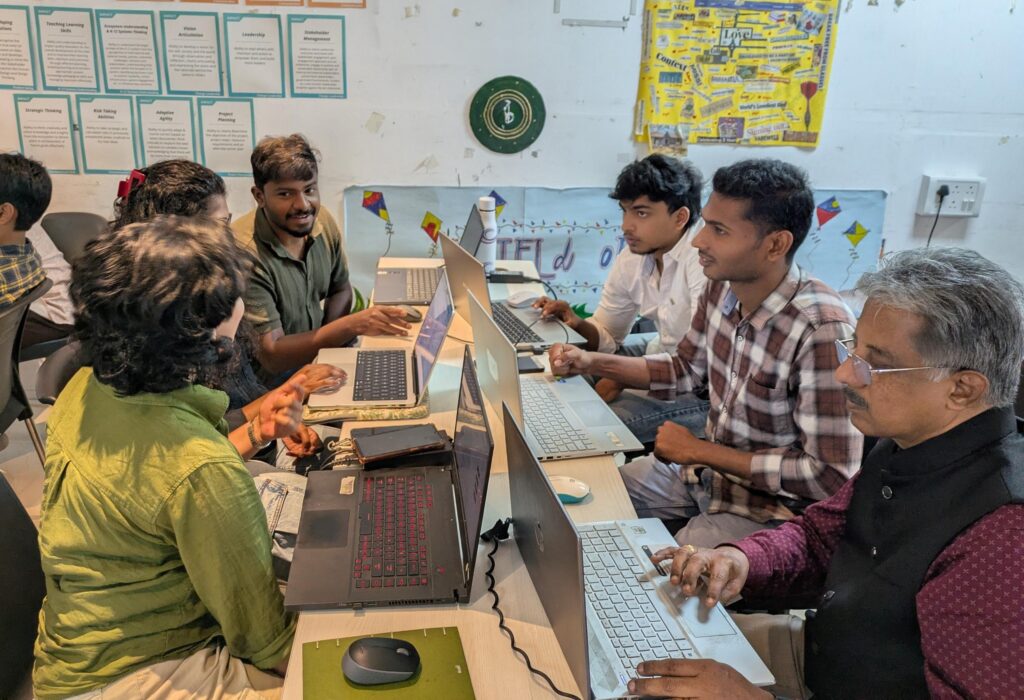
Abdullah, Harini, Kathir, Krithika, Prasanna and Santhosh evaluated the education sector by focusing on the state of government schools in the constituencies in Chennai district. They used UDISE+ data over the years to identify the improvement or lack of it in government schools in different constituencies.
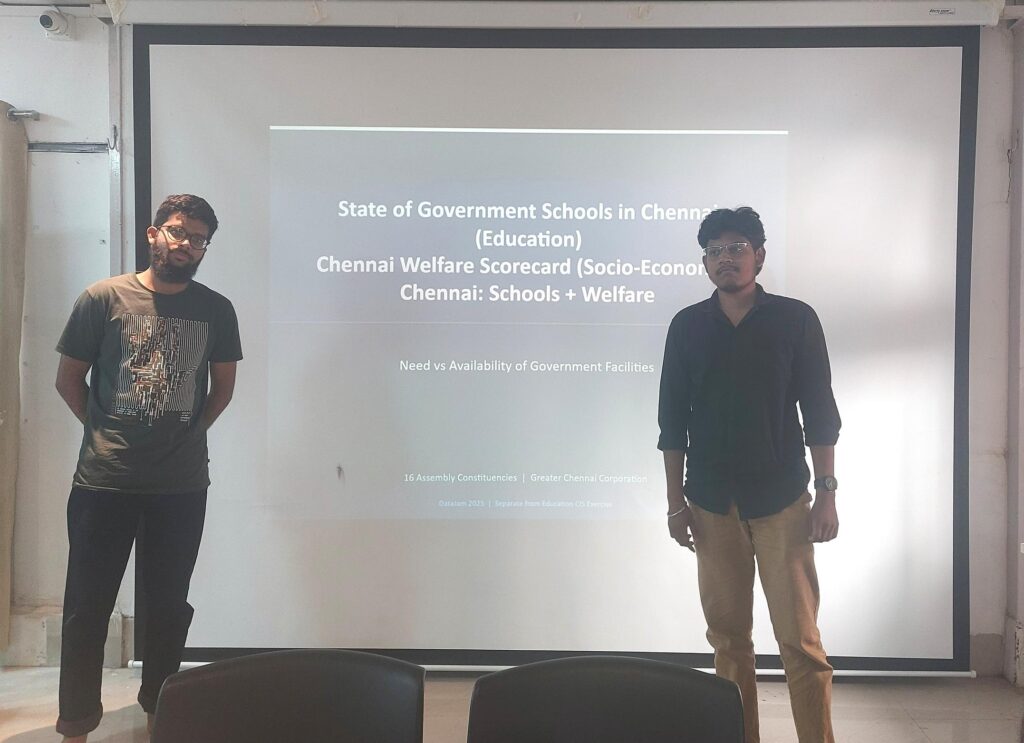
The team evaluated improvement on the basis of change in enrollment, physical infrastructure – classrooms and girls toilets, and teacher quality. They correlated this data with the socio-economic status of different constituencies as per the census and other services offered by the governments. Based on this they identified the constituencies with the most need for government schools and the coverage provided.
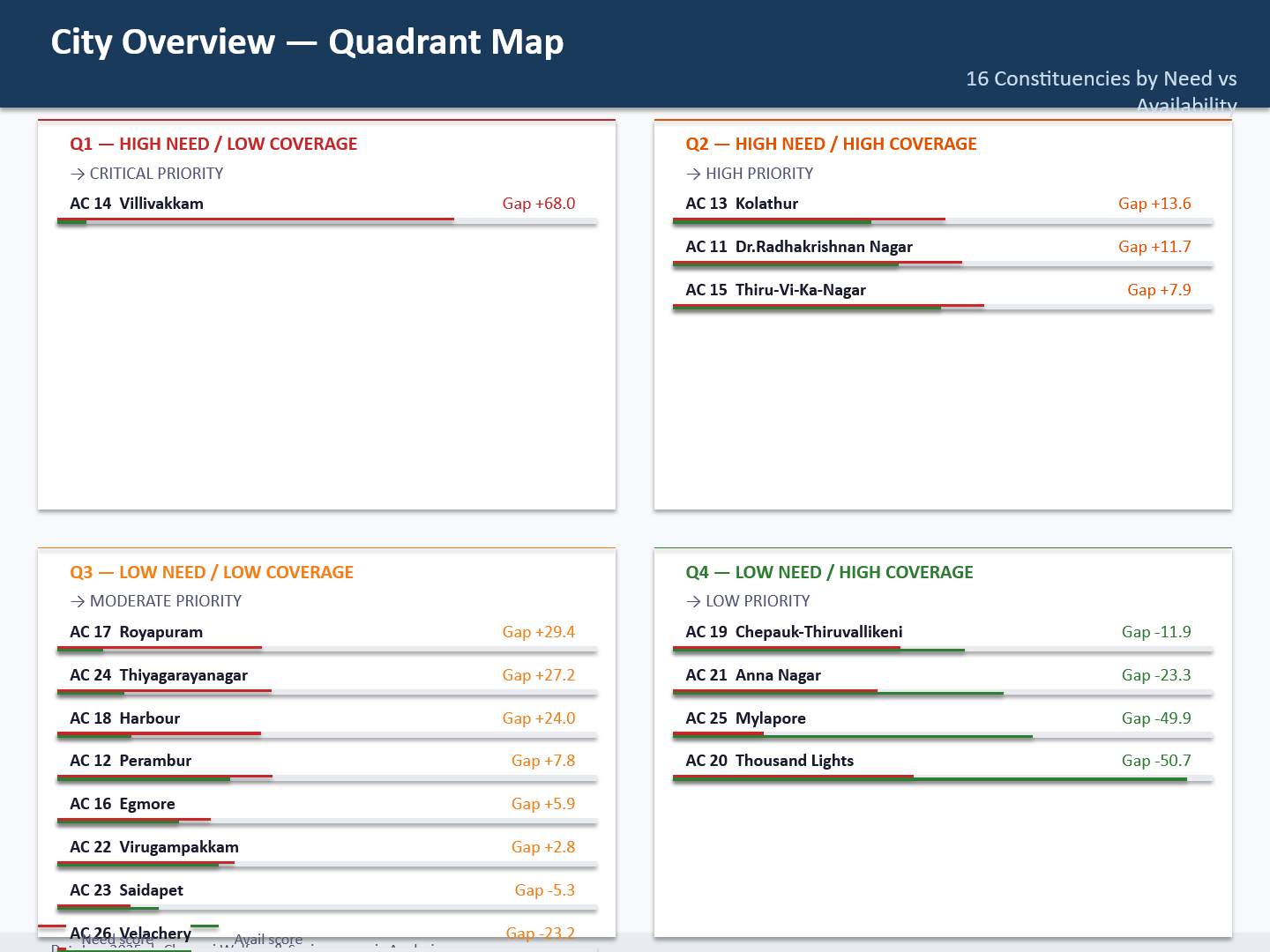
They identified Villivakkam constituency as needing more intervention in government school support, while Kolathur, Dr. Radhakrishnan Nagar and Thiru-vi-ka-nagar have a high need but are also well covered. Constituencies like Mylapore and Anna Nagar were seen to have high coverage of government schools, but they were also found to be socio-economically doing well.
Access to sanitation and sewage network
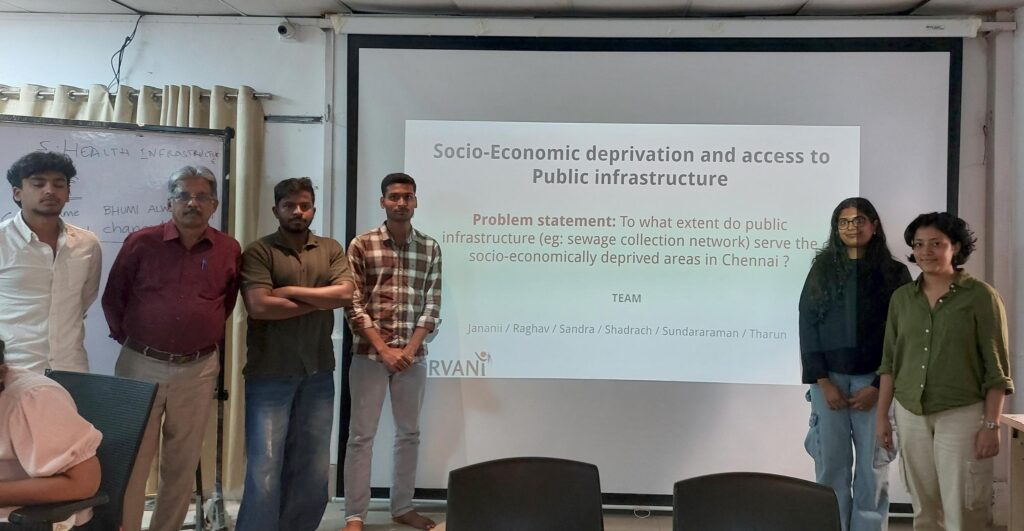
Jananii, Raghav, Sandra, Shadrach, Sundarraman and Tharun evaluated the state of the sewage network to identify constituencies where there are gaps, especially when it comes to coverage of informal settlements.
They noted that out of 887 informal settlements in Chennai, only 543 were connected to the sewage network with the rest 344 falling outside. Among the constituencies, Sholinganallur and Madhavaram needed the most intervention with 61% and 38% of the slums in the two constituencies needing connections respectively.
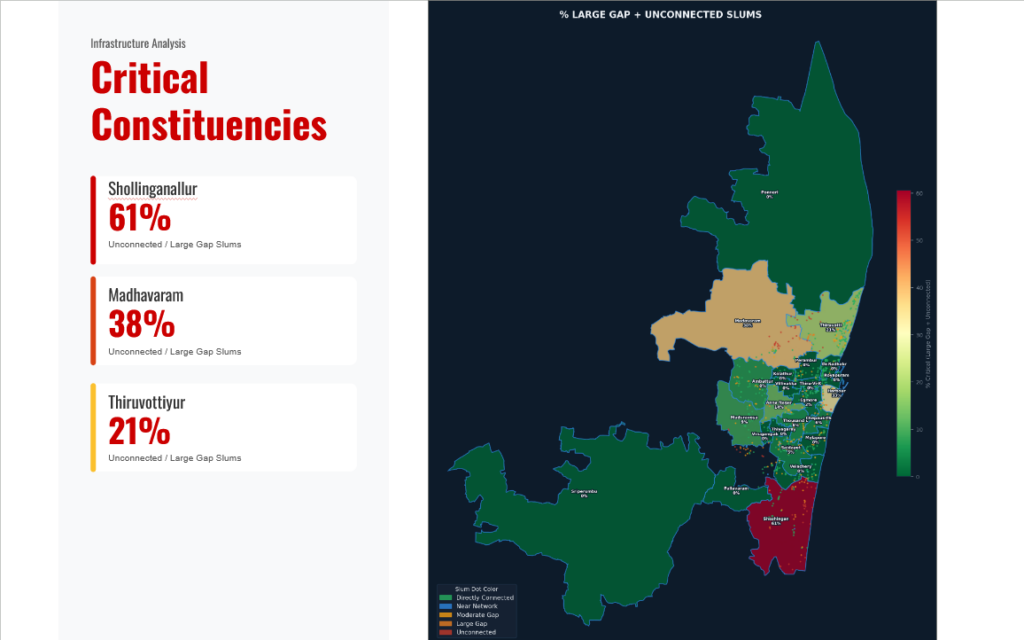
The team also pointed out that many of the unconnected settlements fall next to waterbodies like canals which would suggest that the sewage is flowing into these waterbodies polluting them as well as reducing their flood mitigation capacities.
Urban Heat and mitigation in constituencies
Akshara, Bairavi, Gayathri, Sangami, Udhayamaayei and Vandhana used LST, NDVI and NDBI data from satellites to evaluate the exposure to urban heat in the different constituencies and their access to mitigation measures.
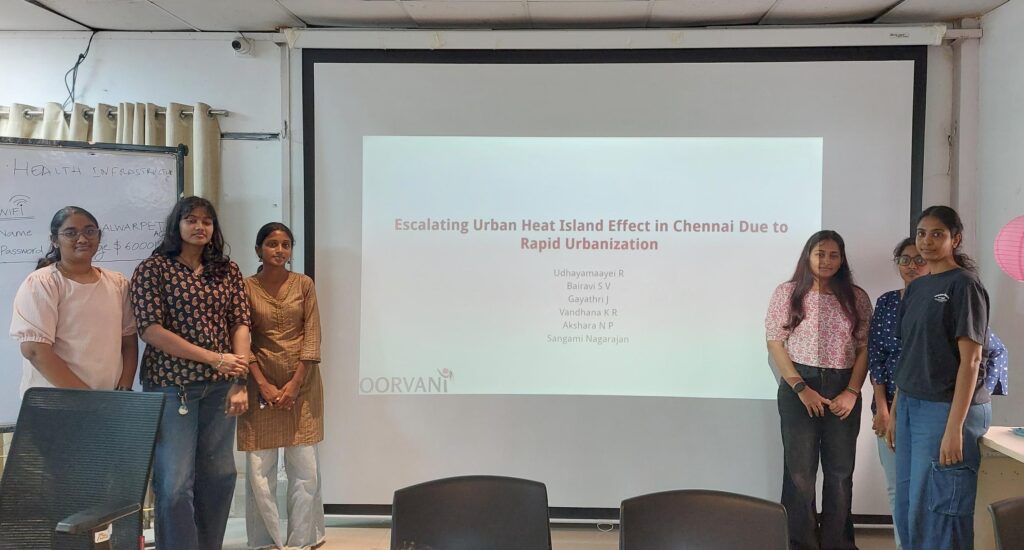
The team noted that Chennai despite being known to be a hot city, is heating up unevenly and the hottest places are where the most vulnerable people live. They analysed three constituencies – Velachery, Ambattur and Royapuram with different land use characteristics for their analysis.
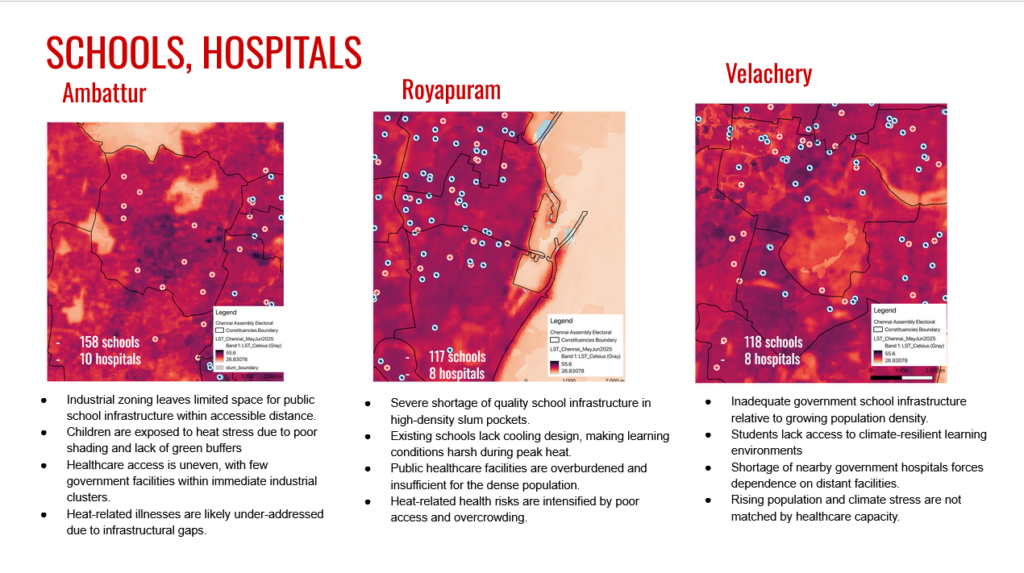
Considering vegetation, built-up area and heat, the team categorised the vulnerability of the constituencies. They found that while Ambattur and Velachery had very high vulnerability, Royapuram was seen to be in critical state because of lack of green cover and presence of a large number of industrial estates.
Civic engagement and correlation to open spaces
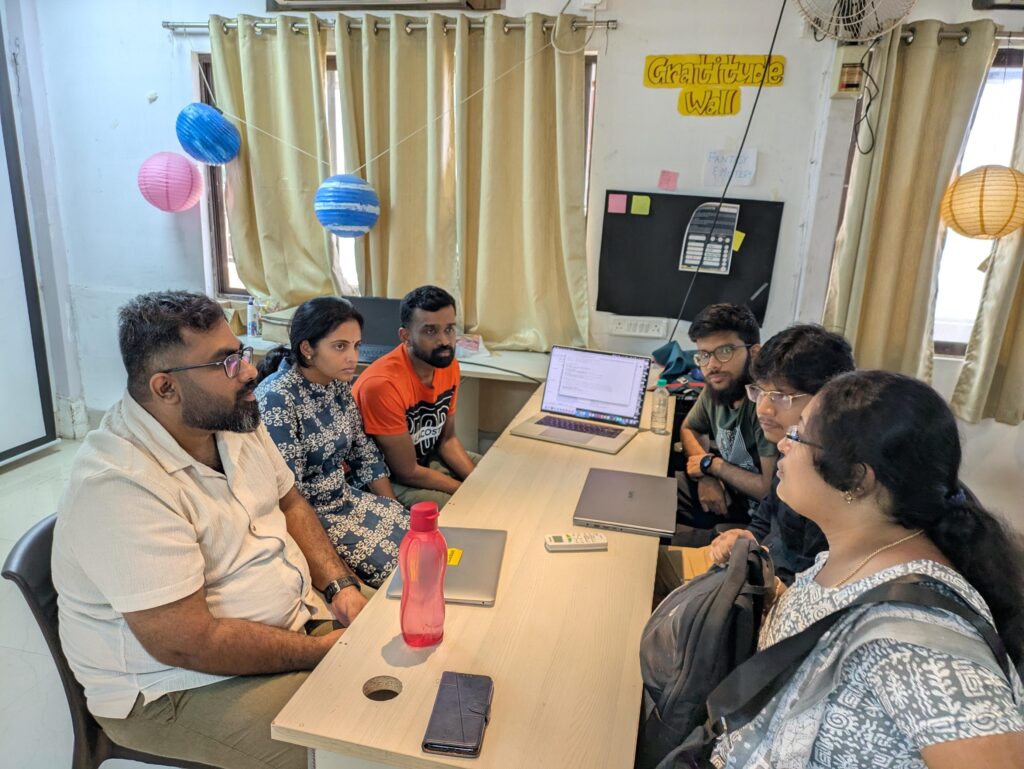
Achuthan, Magesh, Mridhula, Sadhvika, Samyukth and Triveni looked at the civic engagement in three constituencies in different parts of Chennai and correlated with access to open spaces.
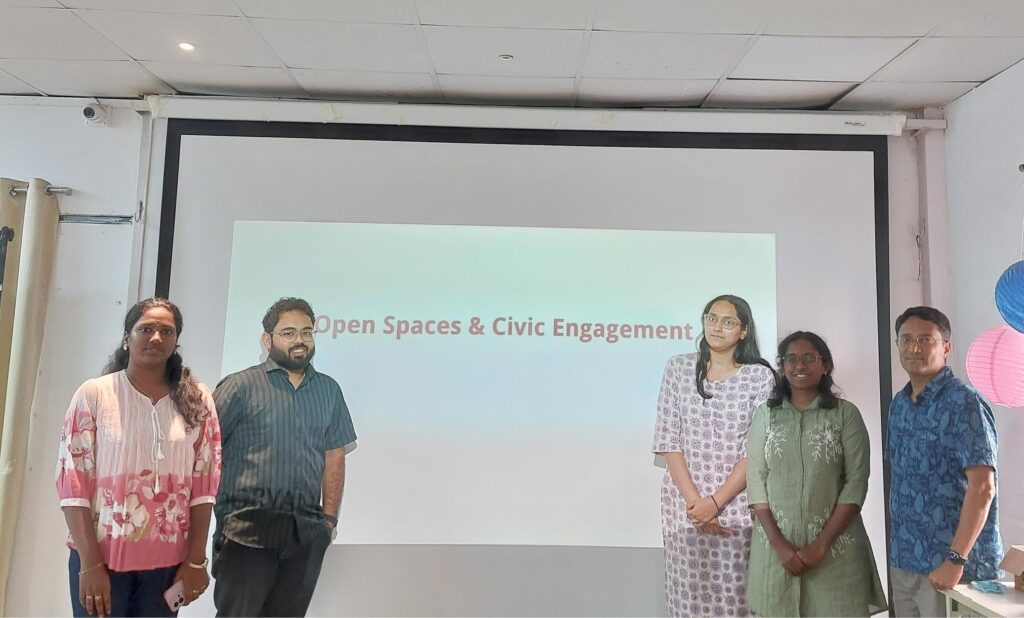
They identified three constituencies – Velachery, Virugambakkam and Thiruvotriyur in the South, Centre and North of Chennai. They noted that while the voter turnout in Thiruvotriyur has always remained high at around 65%, the other two constituencies have been 10 percentage points lower and have seen a declining trend in the last few elections.
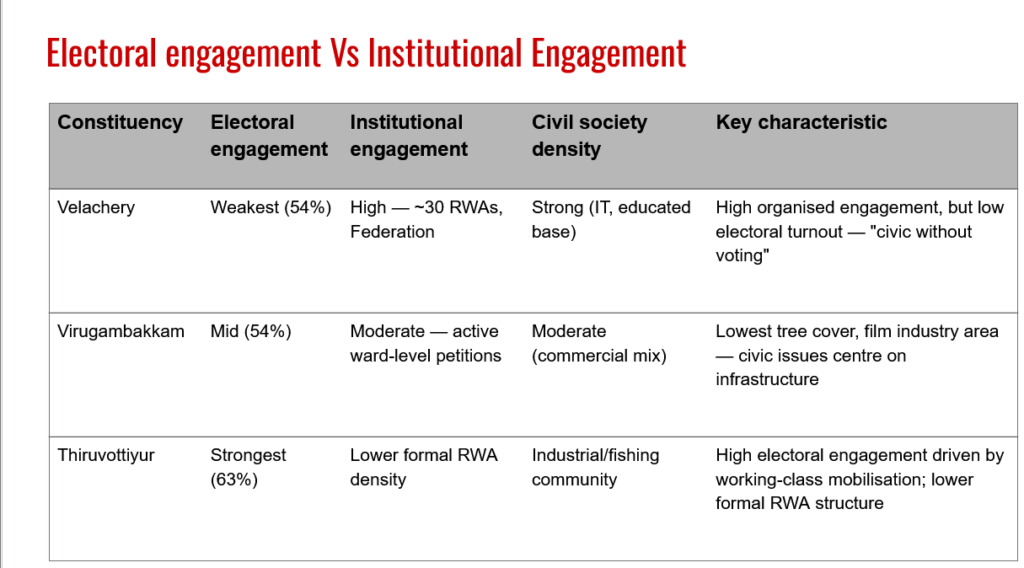
However, the per capita availability of open space was the lowest in Thiruvotriyur and highest in Virugambakkam. The team also highlighted that Resident Welfare Assocation (RWA) density is low in Thiruvotriyur but high in the other two constituencies.
Access to UPHCs in Sholinganallur
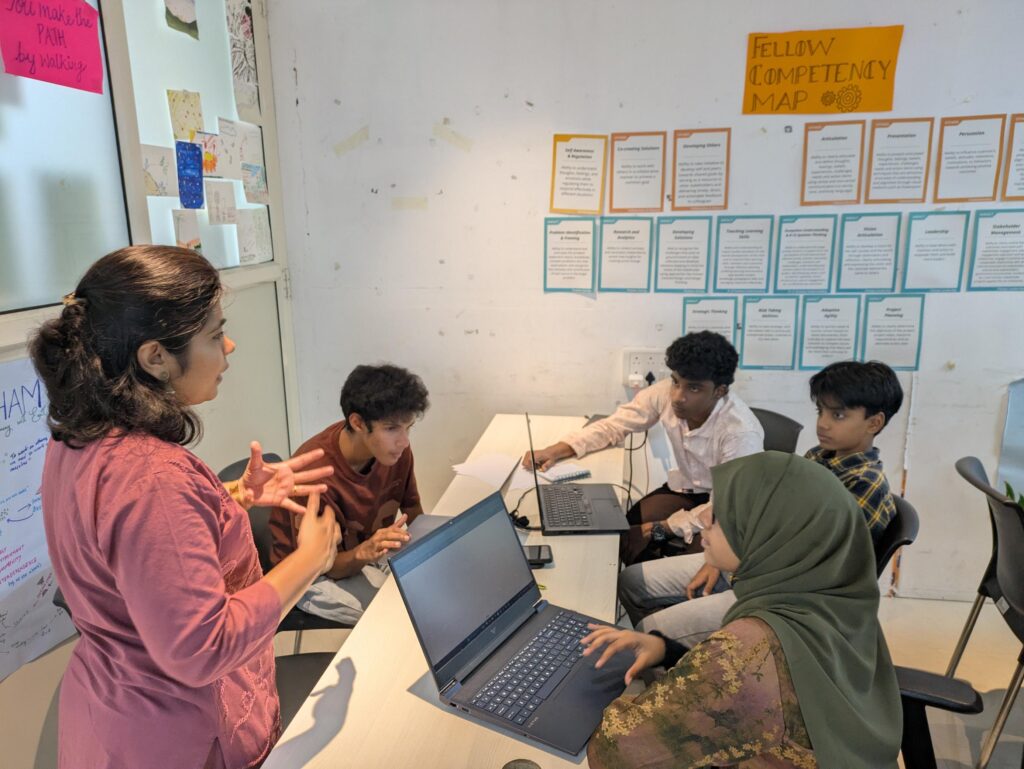
Aishwarya, Aswath, Mandanna, Mansoor, Muiz, Musawwir and Rumaysa, most of whom are students of Sunnyside Learning looked at access to UPHCs in Sholingannallur constituency.
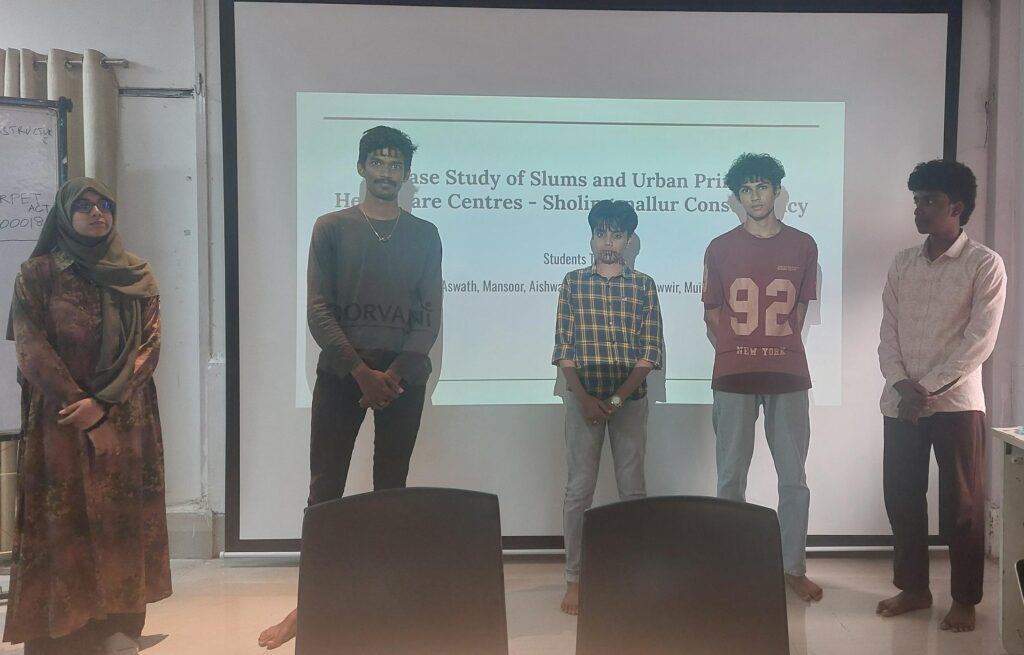
The team noted that every UPHC should serve a population of 50,000 people and analysed the access to UPHCs across Sholinganallur constituency. They found that while there were ten UPHCs in the constituency, their distribution was uneven.
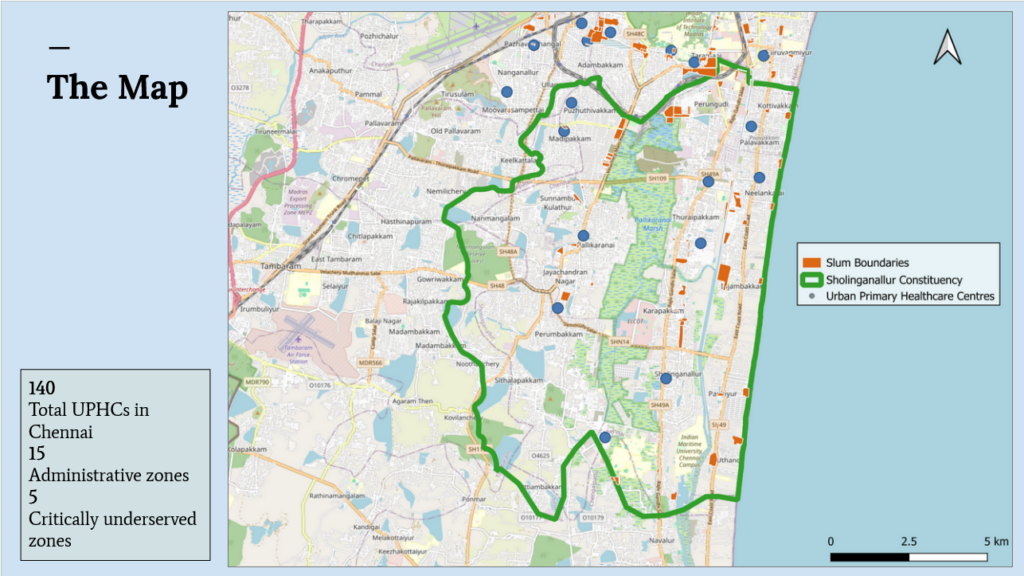
While the Pallikaranai marshland served as a natural barrier dividing the constituency vertically, the southern parts of the constituency were underserved by UPHCs. The southern parts of the constituency also had a higher concentration of informal settlements which would benefit most from UPHCs. The team recommended adding 2-3 more UPHCs in specific areas that could benefit a large population.
Conclusions
With the attention to topics like Urban Heat, sanitation, open spaces or schools, the participants underscored the need to improve public infrastructure and welfare systems, and strengthen delivery of service across constituencies.
Participants highlighted the need for equitable access to education and health – in the form of better government schools and access to UPHCs. They noted that sanitation and access to mitigation and adaptation to urban heat also play a large role in ensuring health equity.
While resettlement of informal settlements is happening to outer areas like Sholinganallur and Semmencherry, the teams noted that access to sanitation, UPHCs etc remains poor.
The datajam highlighted such important and necessary parameters that the newly elected or reelected MLAs can address to ensure better delivery of services and also improve the quality of life in their constituencies.
Santhosh Loganaathan, co-founder of Nagariyal, noted that “it was excellent to see participants from various walks of life come together, united only by their passion for evidence-based public problem-solving, to evaluate where various constituencies stand in various metrics such as Education, Social-inclusion, etc. We need to create more such spaces for public participation and foster a culture of data-based civic action.”
Subramani M, of Citizen consumer and civic Action Group (CAG) added that “the focus on Chennai’s Assembly Constituencies provides a timely opportunity to better understand local development trends and public infrastructure at the constituency level. Such initiatives strengthen data-driven civic engagement and support more informed public discourse.”
For Prasanna, a participant, “we analyzed performance metrics across Chennai’s constituencies on key dimensions such as education, healthcare, socio-economic development, and several other indicators. Initiatives like this highlight the power of data-driven insights in identifying gaps and driving meaningful improvements. It would be highly beneficial if the government could further support and expand these efforts by making structured, high-quality data available across the nation.”