
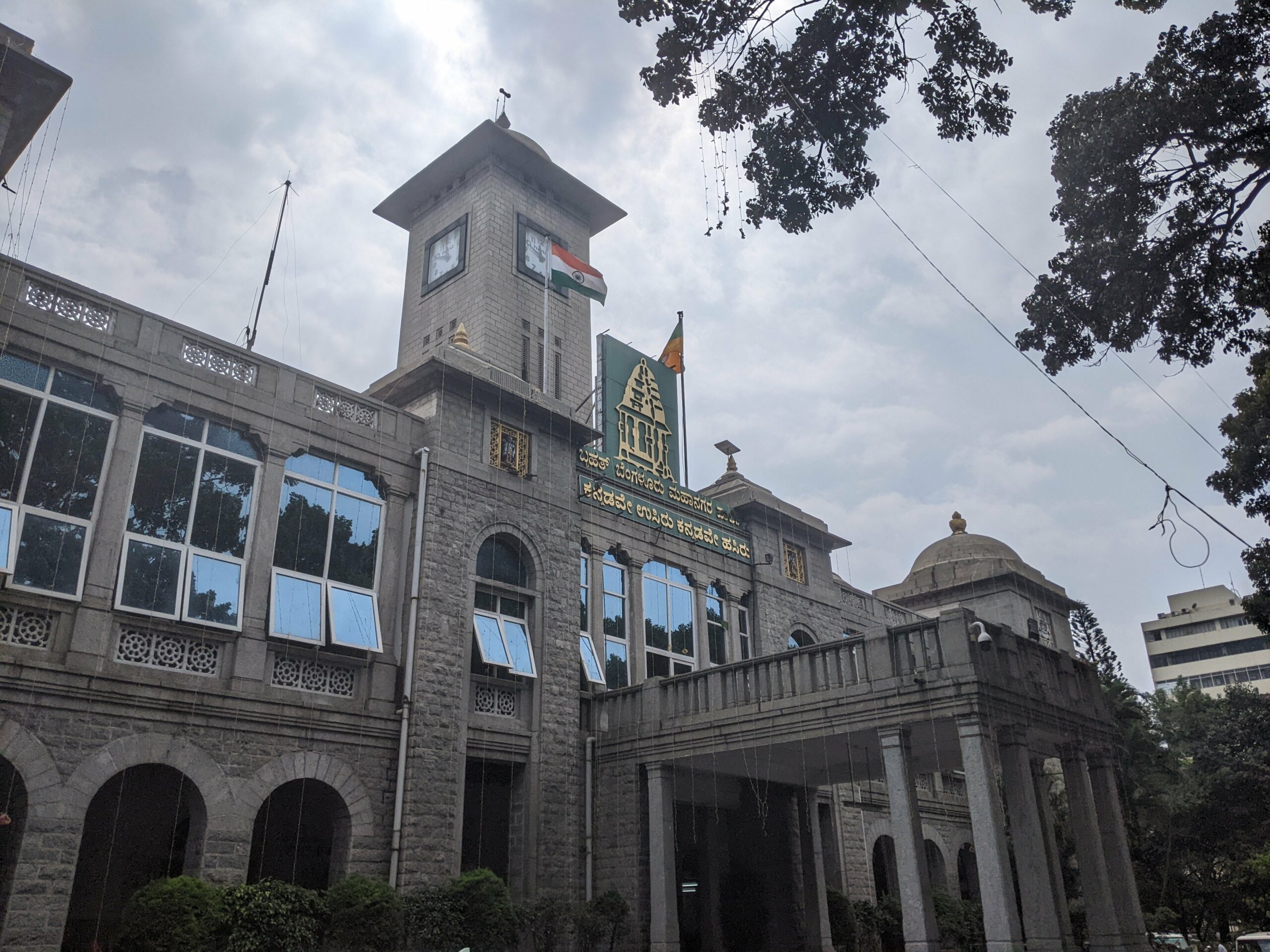
In October 2025 the Greater Bengaluru Authority (GBA) was created from the ashes of the erstwhile Bruhat Bengaluru Mahanagara Palike(BBMP). The area of BBMP was carved into five corporations – Central, North, South, East and West. The 225 wards (or 198 or 243 depending on whom you asked) were also subdivided into 368 wards, and later 369 once it was realised that divisibility by nine was missing. There was also hope that the long pending elections to the local bodies would be held soon.
Exactly a year later, the elections stand postponed to December 2026. While there are protests about SIR and against the Chief Election Commissioner at the national level, at the local level people are busy protesting the elevated corridors, the different Hebbal tunnel roads, one long and one short.
Governance has been through the state government amending different acts to make life easier for themselves. Elevated corridors are being tendered, cancelled and then re-tendered in modified forms. The Bangalore Development Authority also gained a bigger sister called Greater Bangalore Development Authority, which has been busy fighting battles at Bidadi.
Through all this, the local body elections has left the bus quietly without anyone noticing.
Enter Special Purpose Vehicles
When the GBA was formed, it was expected to be an overseeing authority that would unify all local bodies and parastatals like BMTC, BWSSB and BESCOM.
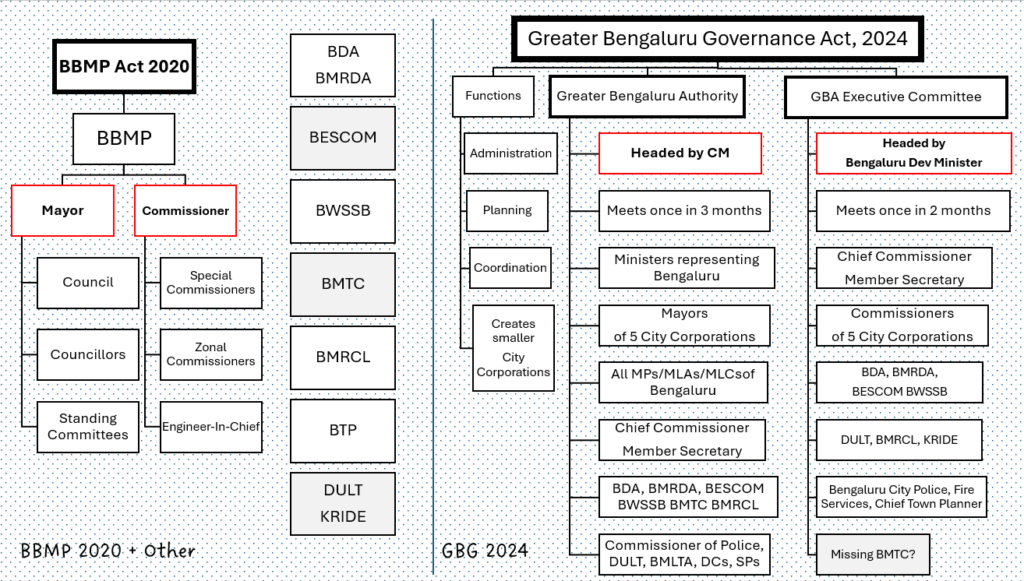
In theory, it suggests that all city related issues except law and order, water, electricity and transport go through the corporations. Once elections happened, elected corporators would be able to decide on the major challenges affecting the city including solid waste management and infrastructure like flyovers, underpasses and road conditions.
However, what is missing in the chart above are two bodies that were launched as Special Purpose Vehicles (SPVs) – Bengaluru Solid Waste Management Limited (BSWML) and Bengaluru Smart Infrastructure Limited (B-SMILE). In theory they report to the Greater Bengaluru Authority, but not under the Corporations.
BSWML was created in 2021 to handle the solid waste of the city, and B-SMILE was created in June 2025 to handle all large infrastructure projects. Large projects like the tunnel roads and the elevated corridors are being implemented by B-SMILE.
The two largest capital functions of the BBMP – waste and building flyovers – were now under the control of SPVs controlled directly by the state government.
Who spends the money?
The budget for 2026-27 estimated that the five corporations would spend close to Rs. 20,000 Crore in total during the Financial Year from April 2026 to March 2027.
However, in the last one year that the five corporations have been in existence, they have totally managed to spend just Rs. 5095 Cr, since October 1st, 2025. This is the amount for which tenders have been published for all the five corporations.
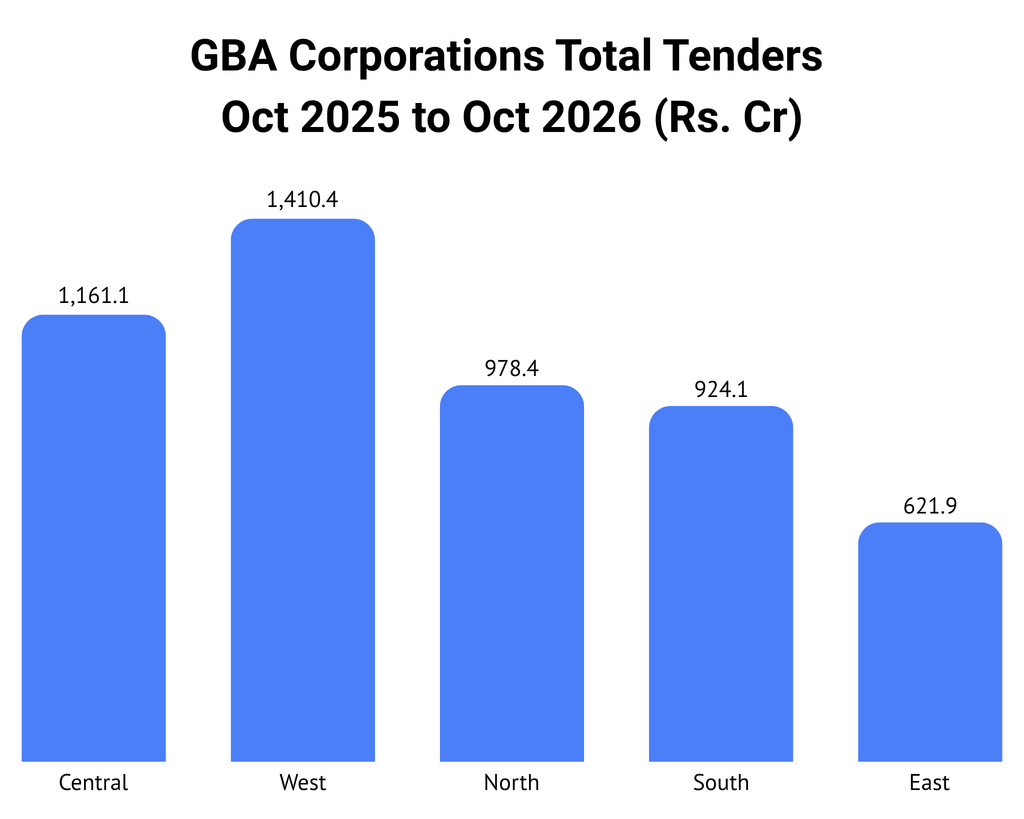
More than 50% of the Rs. 5095 Cr was still spent on roads, footpaths and drains, followed by parks and lakes at 17%. Education, health, solid waste and streetlighting together account for less than 20% of the tenders.
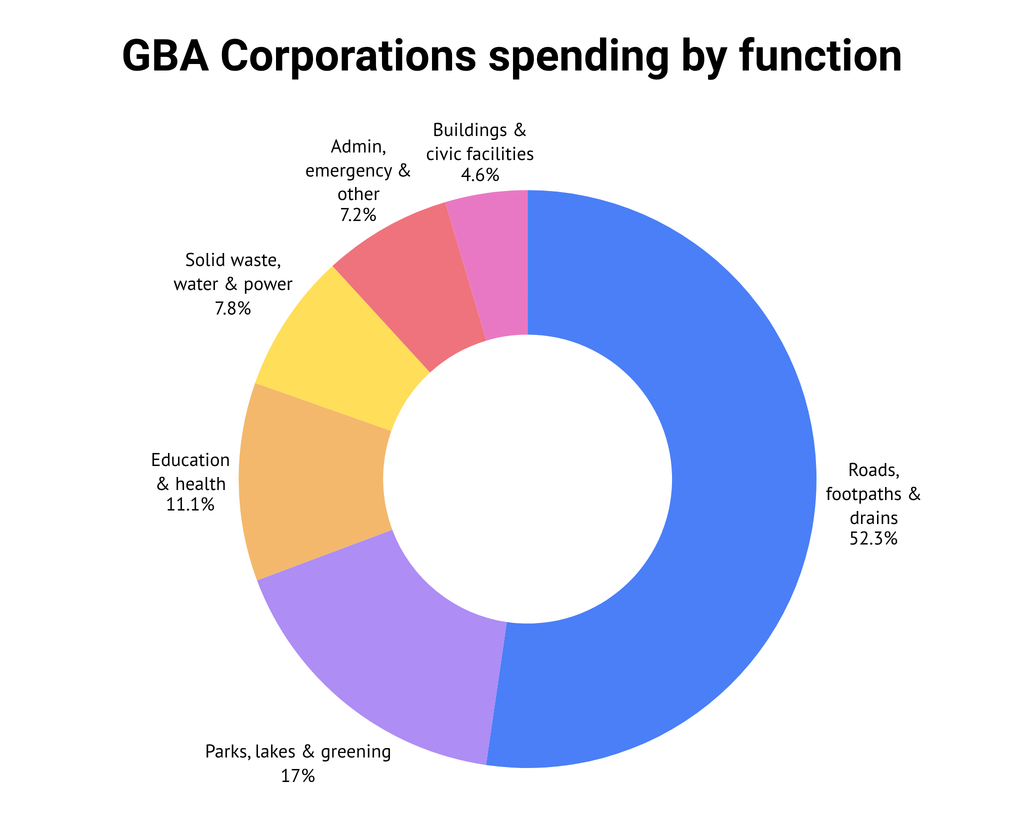
However, the two SPVs have managed to spend more than Rs. 7000 Cr in the same time period. This is considering only those tenders that have been published or awarded. Tenders for many of the elevated corridors were recalled recently. If those are included, the spending shoots up to Rs. 9800 Crore for B-SMILE. BSWML itself has raised tenders higher than each of the five corporations except West City Corporation. This doesn’t include the massive Rs. 39,000 Cr contract given for waste management as the tender is no longer on their site.
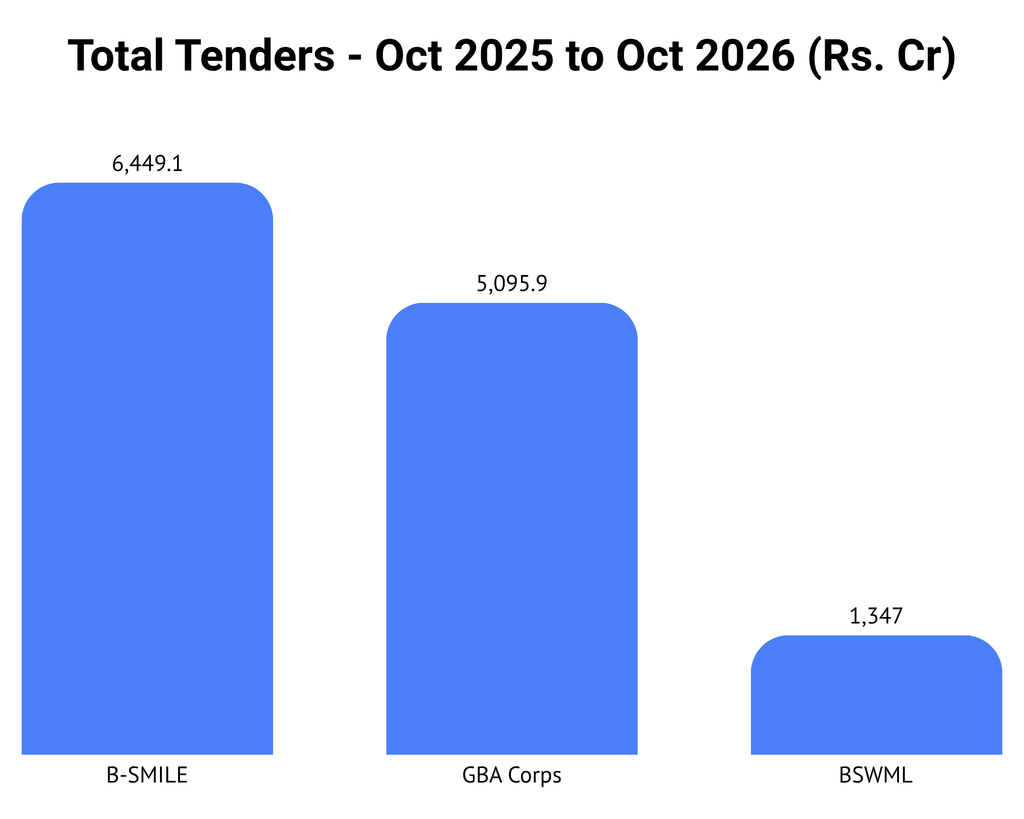
Most of the tenders under B-SMILE have been for the elevated corridors, with the Yeshwantpura to KR Puram corridor and the Marenahalli-Kanakapura Road corridor together costing Rs. 5800 Cr.
One of the most important changes is that even white-topping tenders are being published under B-SMILE with a tender for white-topping major roads in South Bengaluru Corporation for Rs. 120 Cr coming from B-SMILE.
Who will bell the SPV cat?
What all this means is that, assuming elections to the corporations under GBA are held, the 369 elected corporators will not be deciding on major infrastructure projects including which roads get white-topped. They cannot have a say on large parts of solid waste management except door-to-door waste collection anymore.
While it can be argued that large projects like the tunnel roads which connect far away parts of the city and cost thousands of crores are decided by the State government, it is hard to justify why smaller flyovers like the one at MEI junction, or the ones in Raghuvanahalli or Konankunte cross, which fall within a ward each need to be decided by Vidhana Soudha. Even the larger elevated corridors like the Kanakapura Road-Marenahalli corridor and the Mysore Road elevated road, fall within one corporation, if not one ward.
For the larger projects, given that bodies like DULT and BMLTA have been bypassed using legislative loopholes, it is important to ask what role the elected corporators will play in deciding the direction of the city with such projects.
Storm water drains buffers and lake buffers have been shrunk, attempts have been made to encroach parks and to bring in new parking rules, and large infrastructure projects are being proposed almost every other week. All these decisions and legislations are from the Government of Karnataka with no oversight from any of the corporations.
While we look at the likes of Zohran Mamdani and wonder when we will get such mayors for Bengaluru, the five mayors who will be part of the setup, even before they are elected, are already handicapped with the most important decisions already being legislated from Vidhana Soudha.
While we wonder when the elections to the wards in the GBA area will be held, it is also worth asking what the 369 corporators, five of whom would be mayors, will discuss and decide in the councils. With the relentless SPV-fication of Bengaluru’s management, the answer maybe precious little.
[The author would like to acknowledge the support from Vivek M and his site in analysing the tenders data]