
The National Family Health Survey (NFHS) is a large-scale, national household survey conducted by the Ministry of Health and Family Welfare. The survey is conducted roughly every three years, and covers population, health, nutrition, and emerging health issues at the national, state, and district level.
The first round was conducted in 1992–93, with each round tracking a set of measurable health and demographic markers called indicators that allow researchers and policymakers to compare progress over time.
In 2023–24, India conducted the sixth round of the National Family Health Survey (NFHS-6). For the first time, all aspects of the survey were coordinated solely by IIPS, Mumbai. The fact sheets were released on May 29, 2026. The NFHS-6 fact sheet tracks 101 key indicators across health, nutrition, and demographic parameters.
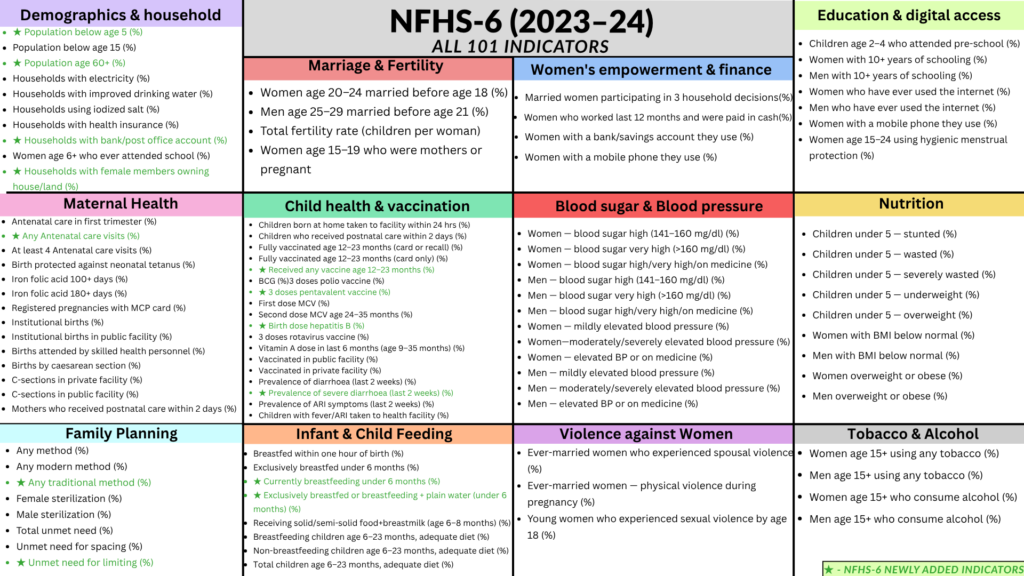
Compared to NFHS-5 (2019–21), which carried 131 indicators, the NFHS-6 fact sheet contains 30 fewer, with 13 new indicators added. The dropped indicators span several categories:
- All three child and infant mortality rates (IMR, NNMR, U5MR),
- All seven anaemia breakdowns across children, women, and men,
- The entire cancer screening section,
- All four HIV/AIDS awareness indicators,
- Method-level family planning data (pill, condom, IUD, injectables),
- sanitation and clean cooking fuel coverage, sex ratio figures, and literacy rates.
The government has said the fact sheets represent only the first stage of data dissemination, and that a fuller national report with additional indicators and methodological detail will follow (Times of India).
| # | Indicators from NFHS-5 that were dropped in NFHS-6 | Category |
|---|---|---|
| 1 | Sex ratio of the total population | Demographics |
| 2 | Sex ratio at birth | Demographics |
| 3 | Children under age 5 whose birth was registered with civil authority (%) | Demographics |
| 4 | Deaths in the last 3 years registered with civil authority (%) | Demographics |
| 5 | Women who are literate (%) | Demographics |
| 6 | Men who are literate (%) | Demographics |
| 7 | Population living in households using improved sanitation facility (%) | Household |
| 8 | Households using clean fuel for cooking (%) | Household |
| 9 | Adolescent fertility rate for women age 15-19 years | Marriage & Fertility |
| 10 | Neonatal mortality rate (NNMR) | Mortality |
| 11 | Infant mortality rate (IMR) | Mortality |
| 12 | Under-five mortality rate (U5MR) | Mortality |
| 13 | IUD/PPIUD (%) | Family Planning |
| 14 | Pill (%) | Family Planning |
| 15 | Condom (%) | Family Planning |
| 16 | Injectables (%) | Family Planning |
| 17 | Health worker ever talked to female non-users about family planning (%) | Family Planning |
| 18 | Current users ever told about side effects of family planning method (%) | Family Planning |
| 19 | Average out-of-pocket expenditure per delivery in public health facility (Rs.) | Maternal Health |
| 20 | Home births conducted by skilled health personnel (%) | Delivery Care |
| 21 | Children with diarrhoea who received oral rehydration salts (ORS) (%) | Child Health |
| 22 | Children with diarrhoea who received zinc (%) | Child Health |
| 23 | Children with diarrhoea taken to health facility or health provider (%) | Child Health |
| 24 | Children age 12-23 months who have received 3 doses of penta or DPT vaccine (%) | Vaccination |
| 25 | Children age 12-23 months who have received 3 doses of penta or hepatitis B vaccine (%) | Vaccination |
| 26 | Women with high risk waist-to-hip ratio (%) | Nutrition |
| 27 | Men with high risk waist-to-hip ratio (%) | Nutrition |
| 28 | Children age 6-59 months who are anaemic (%) | Anaemia |
| 29 | Non-pregnant women age 15-49 who are anaemic (%) | Anaemia |
| 30 | Pregnant women age 15-49 who are anaemic (%) | Anaemia |
| 31 | All women age 15-49 who are anaemic (%) | Anaemia |
| 32 | All women age 15-19 who are anaemic (%) | Anaemia |
| 33 | Men age 15-49 who are anaemic (%) | Anaemia |
| 34 | Men age 15-19 who are anaemic (%) | Anaemia |
| 35 | Women who have ever had a cervical cancer screening test (%) | Cancer Screening |
| 36 | Women who have ever had a breast examination for breast cancer (%) | Cancer Screening |
| 37 | Women who have ever had an oral cavity examination (%) | Cancer Screening |
| 38 | Men who have ever had an oral cavity examination (%) | Cancer Screening |
| 39 | Women who have comprehensive knowledge of HIV/AIDS (%) | HIV/AIDS |
| 40 | Men who have comprehensive knowledge of HIV/AIDS (%) | HIV/AIDS |
| 41 | Women who know consistent condom use reduces HIV risk (%) | HIV/AIDS |
| 42 | Men who know consistent condom use reduces HIV risk (%) | HIV/AIDS |