Transit authorities worldwide are using WhatsApp to deliver ticketing, journey planning, and real-time alerts directly to commuters, without needing apps to be downloaded. India leads this shift, and within India, Bengaluru made history: Namma Metro run by BMRCL was the first transit service in the world to offer end-to-end QR ticketing entirely within WhatsApp, launched on November 1st, 2022. But the city’s bus network, the BMTC, which serves far more daily commuters, is yet to catch up and understanding why requires looking at the data infrastructure underneath.
How cities compare — WhatsApp services by mode
The table below maps which WhatsApp services are available across different transit modes in each city. A ‘—’ means no WhatsApp service exists for that mode in that city as of May 2026.
| City | Bus | Metro | Train / Rail |
| Bengaluru | Basic helpline bot only (route/timing queries) +91 7760991212 | Full QR ticketing, smart card recharge, fares, schedules, refunds — English & Kannada (World’s first, Nov 2022) +91 8105556677 | — |
| Delhi | Full QR ticketing via WhatsApp ‘Quick Purchase’ for regulars UPI, up to 6 tickets/txn (DTC — Apr 2024) +91 8744073223 | WhatsApp ticketing across all Delhi Metro, Noida & Gurugram Rapid Metro routes (DMRC — 2023) +91 9650855800 | — |
| Mumbai | — | QR ticketing via WhatsApp UPI, up to 6 tickets/txn Lines 2A and 7 (MMMOCL — Oct 2024) +91 8652635500 | — |
| Pune | — | E-ticket booking via WhatsApp chatbot (2023) +91 9420101990 | — |
| Hyderabad | — | WhatsApp chatbot sends ticketing URL (L&T; Metro — 2023) +91 8341146468 | — |
| New York | Real-time bus status chatbot (‘Is the 29 bus running?’) (MTA — 2023) | Real-time subway alerts and status via the same MTA bot mta.info | Service alerts for LIRR and Metro-North (MTA) |
| Cape Town / South Africa | Intercity bus booking via WhatsApp (Intercity Xpress) 079 7869989 | — | — |
Namma Metro on WhatsApp
In November 2022, Bangalore Metro Rail Corporation Limited (BMRCL) partnered with WhatsApp and AI platform Yellow.ai to launch a chatbot-based ticketing service for Namma Metro covering 380,000+ daily commuters. It handles ticketing, smart card recharges, fare queries, refunds, and station lookups, all in English and Kannada, without leaving the chat window.
Send ‘Hi’ to +91 81055 56677 on WhatsApp. The bot walks through route selection, fare, UPI payment, and delivers a QR code — no redirect, no app, no account creation.
BMTC — The Bigger Network, The Bigger Gap
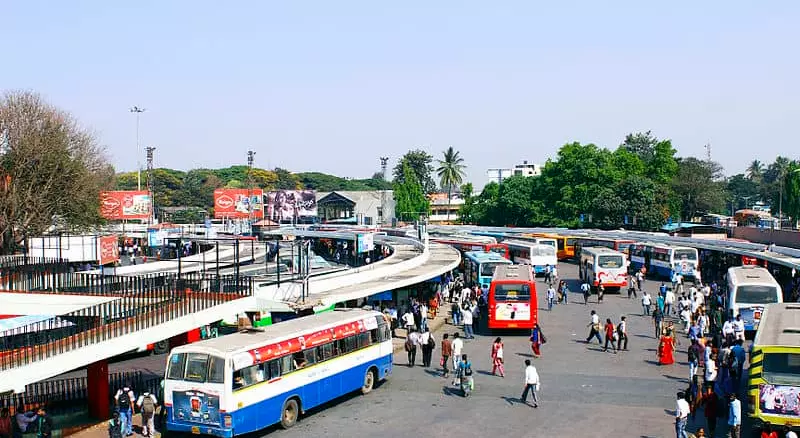
BMTC operates 6,340 buses across Bangalore. More people commute by bus than by metro, particularly those in areas the metro doesn’t reach. BMTC’s WhatsApp presence is currently a basic helpline bot for route and timing queries. Its primary digital channel is the Namma BMTC app, launched in May 2023.
The Namma BMTC App has evolved over the years and now has many good features, including journey planning, fare calculator, and shows real-time status of buses. It is available for both iOS and Android, and even has a web version, which has improved over the years but has issues. User reviews describe crashes when tracking buses, servers going down, and GPS data that updates every 15 minutes or longer — making it less useful for deciding whether to wait. The GPS hardware has been on BMTC buses since 2016 (Intelligent Transport System project). The issue isn’t equipment — it’s that the data isn’t reaching commuters reliably. This is where GTFS RT (Real Time) becomes important.
GTFS — The Missing Link
GTFS stands for General Transit Feed Specification. It is an open, standardised data format that transit agencies use to publish their schedules, routes, stop locations, and fares in a way that any application can consume. Over 10,000 public transport agencies in 100+ countries use it. When you check a bus on Google Maps, GTFS is almost certainly involved.
There are two versions. GTFS Static covers fixed schedules routes, stop names, timetables, fares. GTFS Realtime (GTFS-RT) is the live layer of actual vehicle positions, arrival predictions, and service alerts, updated as the bus moves. The connection to GPS is direct: a GPS tracker on a bus produces a location signal, which gets converted into GTFS-RT format and published to a feed that apps and chatbots can read. GTFS helps us know the bus routes, stops and schedules and GTFS-RT helps us determine ‘where’ the bus currently is and when it can be expected.
The GPS → GTFS pipeline
— A GPS device on a bus transmits its location every few seconds
— Location data feeds into a Transit Management System (TMS)
— TMS converts raw GPS into GTFS Realtime format (vehicle positions + trip updates) — GTFS-RT feed is published to a server (open or restricted access)
— Apps, WhatsApp bots, and journey planners read the feed and show commuters: ‘Bus 500C arriving in 4 minutes’
BMTC’s GPS infrastructure exists. What has been missing is the GTFS layer on top of it the standardised feed that turns raw location pings into something a WhatsApp bot (or any app) can actually query and display.
What’s changed in Bengaluru
In June 2024, BMTC and BMRCL announced they would open their transit data on a public GTFS portal, modelled on Delhi’s Open Transit Data platform. BMTC is committed to publishing static schedule data first, with GTFS Realtime to follow. The announcement came alongside the ‘Enroute Challenge’, a hackathon run by WRI India, Villgro, and Mercedes-Benz R&D India, where startups Tummoc and Namma Yatri were selected to build Mobility-as-a-Service apps using the open BMTC and BMRCL GTFS feeds.
BMTC’s IT Director, speaking at the announcement, called it the first time BMTC data had been made available in ‘a global open data standard.’ However, the data has not been made public officially.
This matters for WhatsApp. Once BMTC publishes reliable GTFS Realtime data, a WhatsApp chatbot can query it directly, giving commuters live arrival times without needing the Namma BMTC app at all. The data pipeline becomes the foundation for everything else: ticketing, tracking, journey planning, and service alerts.
What a full BMTC WhatsApp service would look like
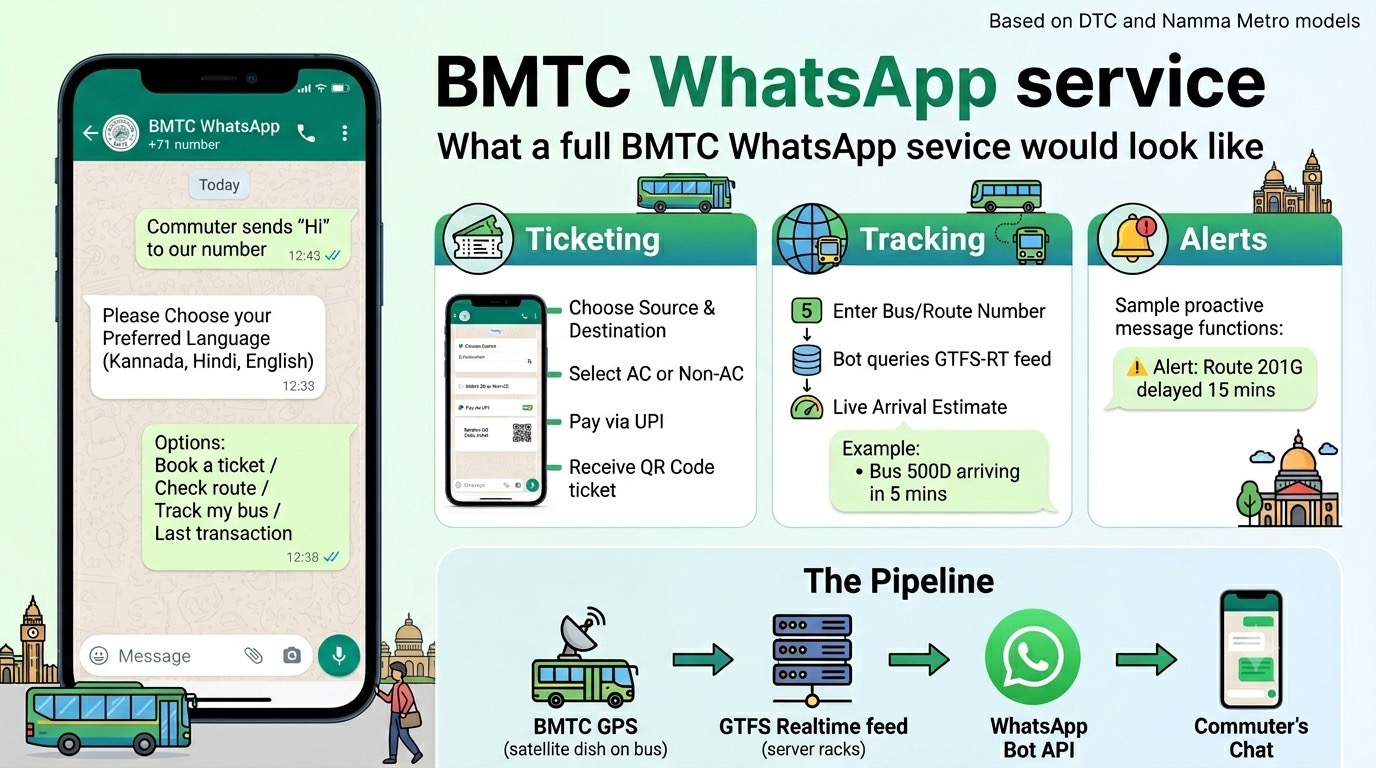
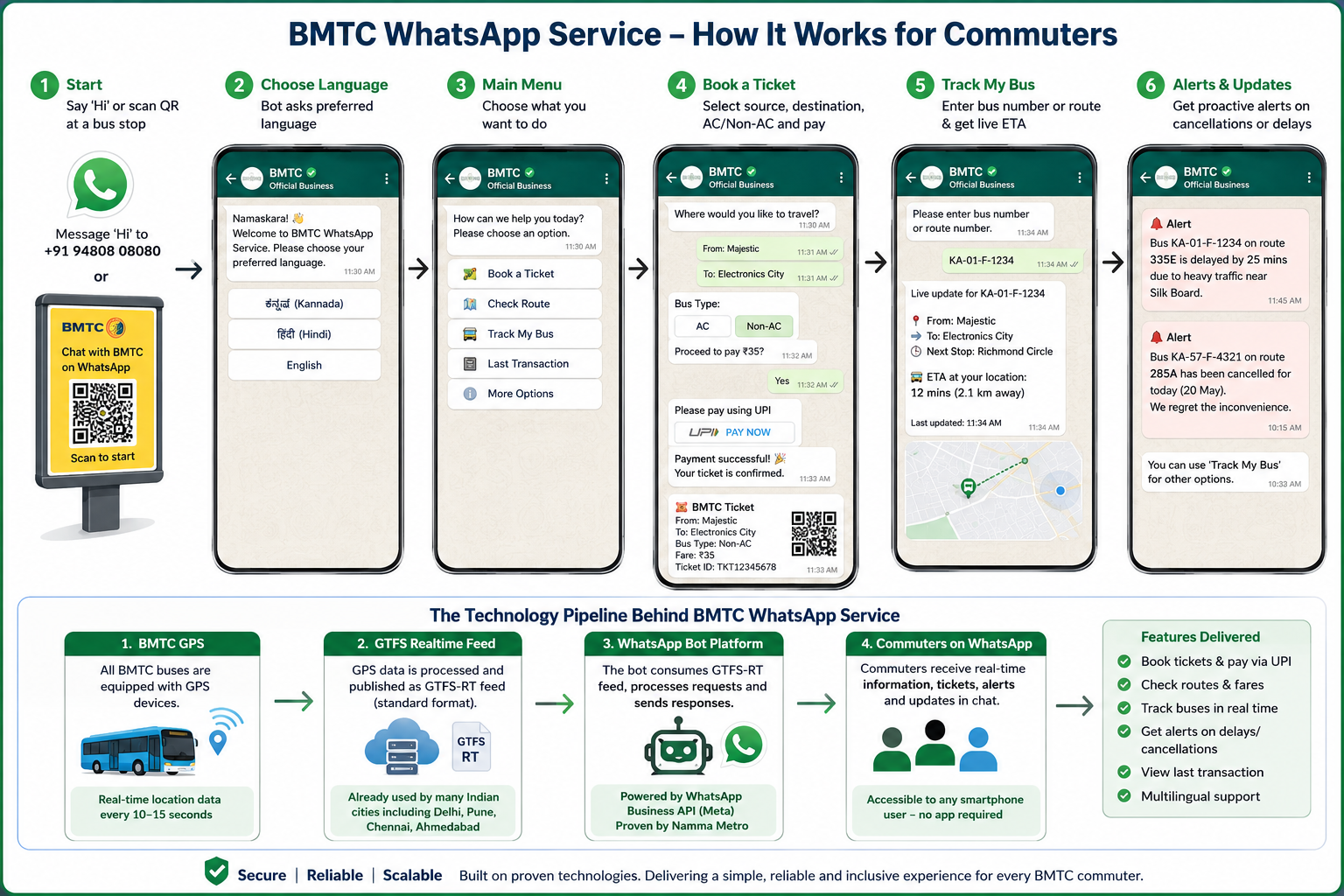
Delhi’s DTC provides the clearest model. Based on that and Namma Metro’s implementation, a realistic BMTC WhatsApp service would work like this:
— Commuter sends ‘Hi’ to a BMTC WhatsApp number or scans a QR at a bus stop — Bot asks: preferred language — Kannada, Hindi, or English
— Options: Book a ticket / Check route / Track my bus / Last transaction
— Ticketing: choose source and destination, AC or non-AC, pay via UPI, receive QR code
— Tracking: enter bus number or route — bot queries GTFS-RT feed and returns live arrival estimate based on current location of user
— Alerts: proactive WhatsApp message if a bus is cancelled or significantly delayed
— The pipeline is: BMTC GPS → GTFS Realtime feed → WhatsApp bot API → commuters’ chat. Each link in that chain is either already built or already proven elsewhere in India.
Bottom line
Bengaluru has two parallel stories. Namma Metro’s WhatsApp integration is a genuine world first, well-designed, functional, and widely used. BMTC, which carries more commuters, is stuck at helpline-bot level despite having published GTFS data on its buses since 2016. The 2024 GTFS Realtime feed is the critical unlock: once BMTC publishes reliable real-time data, building a WhatsApp service comparable to Delhi’s DTC becomes straightforward. The infrastructure question is nearly resolved. The product question of who builds the WhatsApp layer on top is still open.
The pipeline is: BMTC GPS → GTFS Realtime feed → WhatsApp bot API → commuters’ chat. Each link in that chain is either already built or already proven elsewhere in India.
With nearly 7,000 buses and a daily ridership of 48 lakh compared to Namma Metro’s, 7.5 lakh daily riders, BMTC is one of the largest bus networks in the world. Namma BMTC is a genuine step forward in bringing real-time information to commuters, but it requires users to download a separate app and learn its features. WhatsApp, on the other hand, is nearly universal in India, with 89% of smartphone users already on the platform, offering a familiar interface with no downloads or storage constraints. A BMTC WhatsApp chatbot that draws on GTFS data to deliver both static and real-time bus information would be a valuable addition to BMTC’s technology stack and could be the nudge that turns Bengaluru’s “nearly resolved” infrastructure question into India’s next WhatsApp transit success story, inspiring other cities to follow suit.