
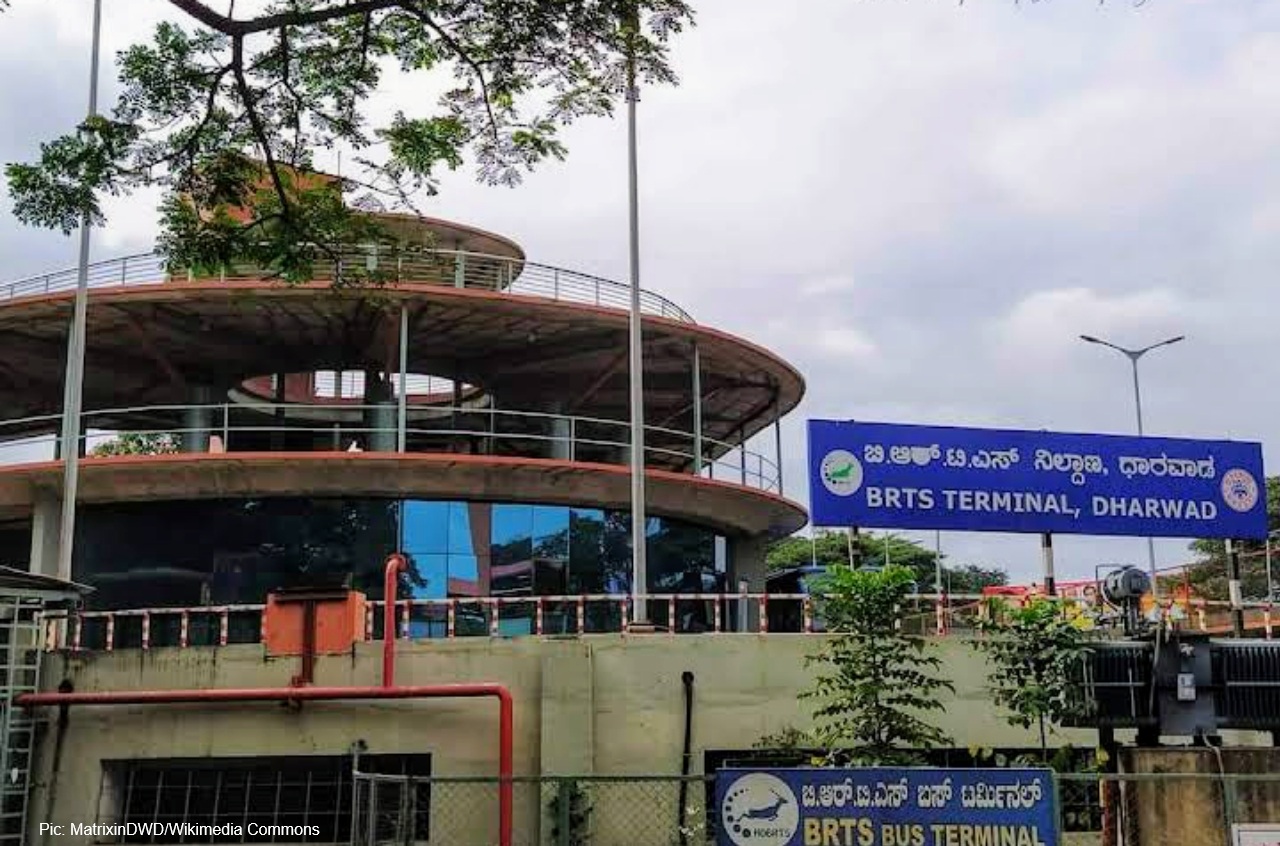
Over the past two decades, multiple Indian cities experimented with Bus Rapid Transit Systems (BRTS) as a way to improve urban public transport through dedicated bus corridors and more reliable bus operations. As of May 2026, the story of BRTS in India presents a mixed picture. Cities such as Ahmedabad, Surat, Rajkot, Raipur, and Hubli–Dharwad continue to operate BRT systems, while Pune–Pimpri Chinchwad, Vijayawada, and Amritsar currently run only limited or partly operational services. At the same time, BRTS systems in Delhi and Bhopal have been dismantled. Dismantling of BRTS lanes is currently underway in Indore and Jaipur, while BRTS operations in Jodhpur remain suspended.
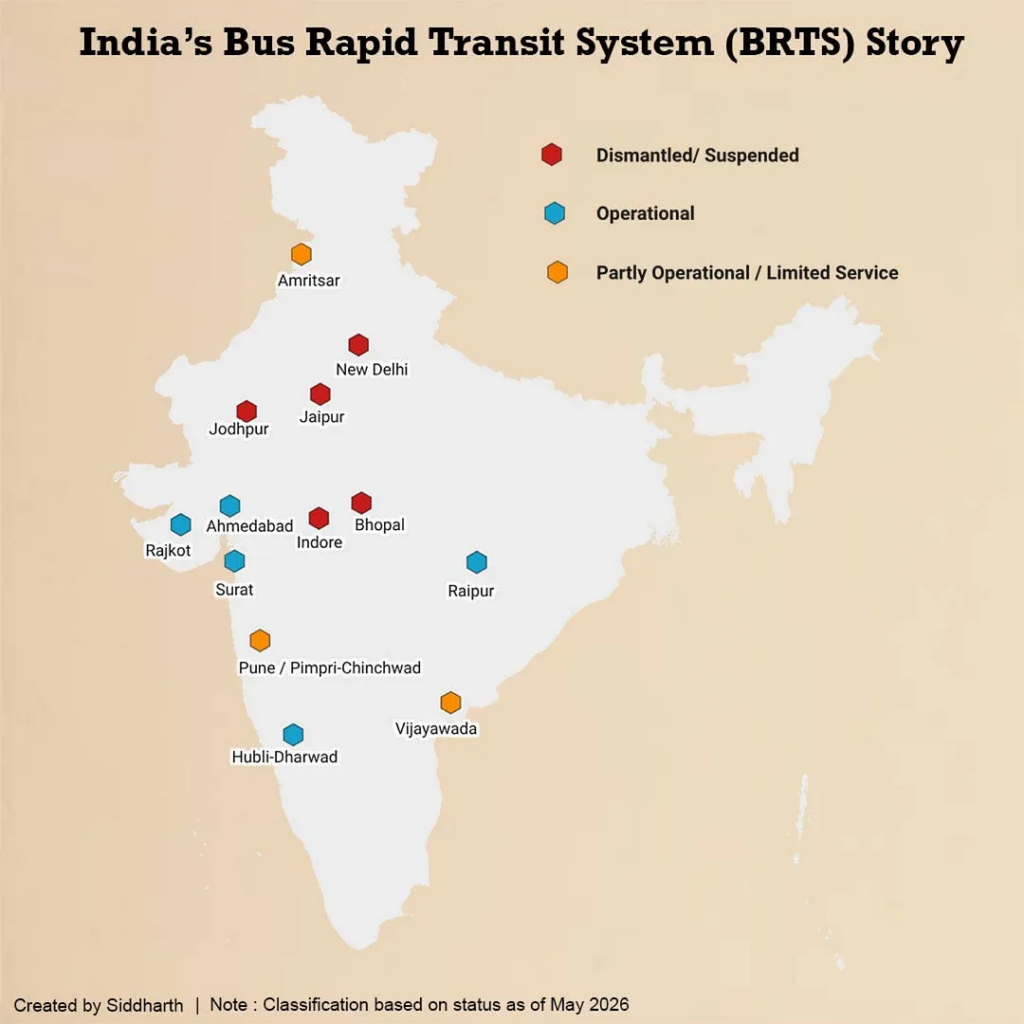
A study of the cities where BRTS is dismantled or being dismantled reveals how these cities arrived at the same outcome through a pattern of design compromises, weak enforcement, public backlash, and political response.
To begin with, it starts with how the system is built and managed. In Delhi BRTS, bus lanes were not fully protected and often mixed with general traffic. In Bhopal and Indore BRTS, unauthorized vehicles frequently entered the BRT corridors, while the systems increasingly became associated with congestion and operational inefficiencies. In Jodhpur, BRTS suspension was linked to a payment dispute between the operator and the municipal corporation, while Jaipur BRTS faced growing criticism around congestion and road space allocation.
Before delving into the causes amd triggers in each of these cities, it is crucial to understand that the most basic and essential aspect of a BRTS system is that it requires exclusive space, and when that is compromised, it begins to lose its advantage. When buses slow down due to mixed traffic operations, travel times increase. As a result, what is is meant to be a fast and efficient system starts behaving like any other bus stuck in traffic , leading commuters to starts questioning its efficiency
Although dedicated lanes are an essential part for BRTS operations, it may be rendered ineffective if there is no strict Enforcement. The success of a BRT system depends on keeping its lanes exclusive to buses. It is not a minor detail to be treated with flexibility but rather as the foundation of the BRTS system. If private vehicles enter these lanes and lane discipline is not enforced, bus speeds drop, and the corridor loses its purpose as the schedule becomes unreliable and the system no longer functions as intended.
Another crucial aspect of a BRTS is the network and scale of operations. If BRTS lanes are limited to a short pilot corridor as and not expanded to a larger network over the years, they have little impact and visibility and integration into the broader Public Transport system. The consequnce behind this lack of measures is that the full potential of the system is not realised.
Smaller pilot stretches around 10 km are insufficient to demonstrate the full benefit/potential of the system, where only a small share of commuters experience it’s benefits. It is evident that the BRTS with short pilot stretches failed to demonstrate clear advantages at scale, and therefore became easier for criticism and frustration to grow amongst the public.
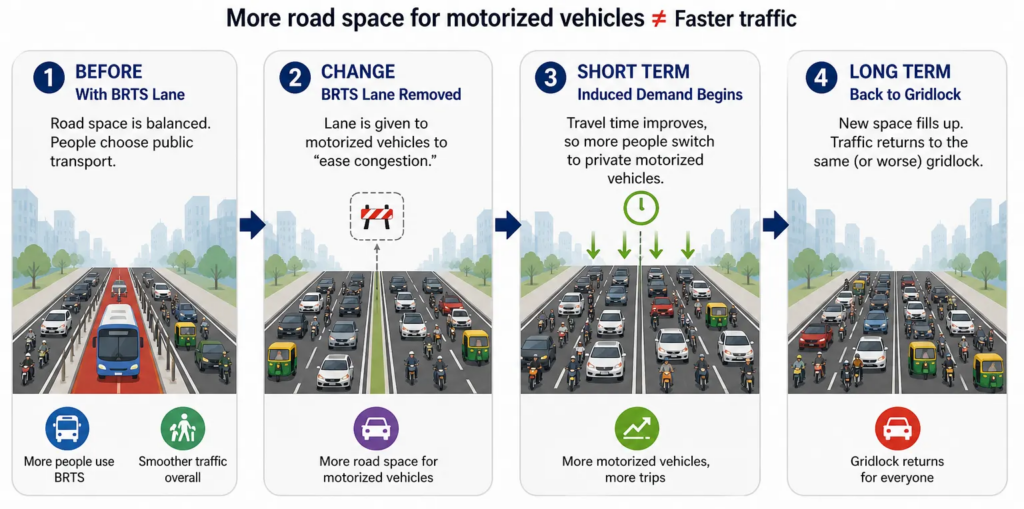
Another under discussed but highly influential factor is the dominance of motorized mode-focused thinking in urban transport decisions. In several cities where BRTS was dismantled, one common trigger was the reallocation of road space. Giving a dedicated lane to buses meant taking space away from motorized private vehicles. Even when the intention was to move more people efficiently, the immediate experience for some commuters was slower vehicle movement, resulting in backlash.
All of the above examples point a deeper systemic issue where urban transport decisions prioritize how quickly vehicles can move rather than how many people can be moved .i.e., short-term convenience for car and motorized mode users tends to outweigh the long-term efficiency of Public Transport for the city as a whole.
Communication and public outreach also play a significant role when introducing a new system in a city. Without clear communication, even a well-designed system can struggle to gain public acceptance. In the case of BRTS, it is important to communicate why dedicated lanes are necessary and what long-term benefits they provide. This helps create a sense of collective effort and shared understanding among the public.
At the same time, the absence of a strong narrative supporting BRTS and its benefits often allows discussions to be dominated by concerns about congestion and accidents, shaping public opinion without a broader understanding of the system’s overall goals and intended outcomes. Once public perception begins to turn negative, maintaining long-term political support becomes increasingly difficult
Transport projects like BRTS require gradual systemic improvement and patience. Their benefits — such as reduced congestion, better accessibility, and improved public transport — take time to become fully visible. But the downsides, like reduced road space for cars and motorized vehicles, are immediate and highly visible. However, this creates a dilemma for those within the political circles. Backing BRTS means defending a system that is initially unpopular, while its advantages are still emerging.
This was clearly visible in cities like Bhopal and Indore, where shifts in political priorities played a significant role in reversing the BRTS investment, while in Delhi, sustained public and media pressure influenced the outcome.
Over time, a narrative starts to take shape: the system is inefficient, or worse, that it is actually causing congestion, which were among the reasons cited in Bhopal and Indore for dismantling the system
This narrative does not stay limited to everyday conversations, it gets amplified — by media coverage and eventually by political voices. Once that happens, the system is no longer judged as a long-term investment but as an immediate problem that needs fixing. The result, as seen in the cities, was a decision to dismantle or suspend the system altogether.
Taken together, these experiences point to a larger conclusion. The failure of BRTS in these cities was not simply about buses or corridors, but about how the system was planned, implemented, managed, and communicated. This pattern was visible across multiple BRTS cities, where the system became an easy target and was often blamed for congestion, regardless of whether it was actually the root cause. While the more effective response could have been gradual and phased improvements to the system, decision-makers instead leaned toward removing dedicated bus lanes and expanding space for general traffic. This, in turn, sets a negative precedent for future public transport investments across the country.
For a BRTS system to work in any city it is to be treated as a complete public transport system, not just a road project. It needs dedicated space, consistent enforcement, clear communication, and long-term political support. Without these, even a well-intentioned project can enter a cycle of decline.
What happened in these cities is not unique, and that is precisely why it matters. The same patterns can repeat elsewhere if the underlying issues are not addressed. But the same logic also offers a way forward. If the system is designed and supported properly, those negative loops can be replaced with positive ones — where better performance builds trust, and trust builds support.
At its core, the debate around BRTS was never only about buses. It was about what cities choose to prioritize — moving more people efficiently, or preserving road space for private vehicles. The experiences of these cities show how easily long-term public transport goals can be undermined when short-term pressures dominate decision-making.
In the end, the lesson is straightforward. These were not random failures. They followed a pattern. And understanding that pattern is the first step toward building holistic transport systems that function as part of a larger urban mobility network and earn long-term public support.
Note: AI tools were used selectively for visual generation, language refinement, and structuring support. The analysis, interpretation, and conclusions presented in this article are the author’s own.
[This article was republished with permission from the author’s blog. You can read the original here. The author can be followed on linkedin.com/in/mohanasiddharth where he is quite active and posts regularly on Transport and Mobility related topics.]